




Diabetic Kidney Disease: The Complication You Won’t Feel
If you have diabetes, you have probably been told to watch your eyes and your feet. Both are good advice. But the complication that most often ends in dialysis is the one you cannot see, cannot feel, and will not notice until a great deal of damage is already done.
In 2018, a nationwide Malaysian study found that 15.5% of Malaysian adults had chronic kidney disease — roughly one in six. The figure had risen from 9.1% just seven years earlier. Most striking of all: of the people in that study who were found to have kidney disease, only 5% knew they had it.
Among Malaysians living with type 2 diabetes, the picture is more sobering still. A 2022 audit of more than 80,000 patients attending public health clinics found that 56.7% already had diabetic kidney disease.
That is more than half. And almost none of them felt sick.
What diabetes does to our kidneys
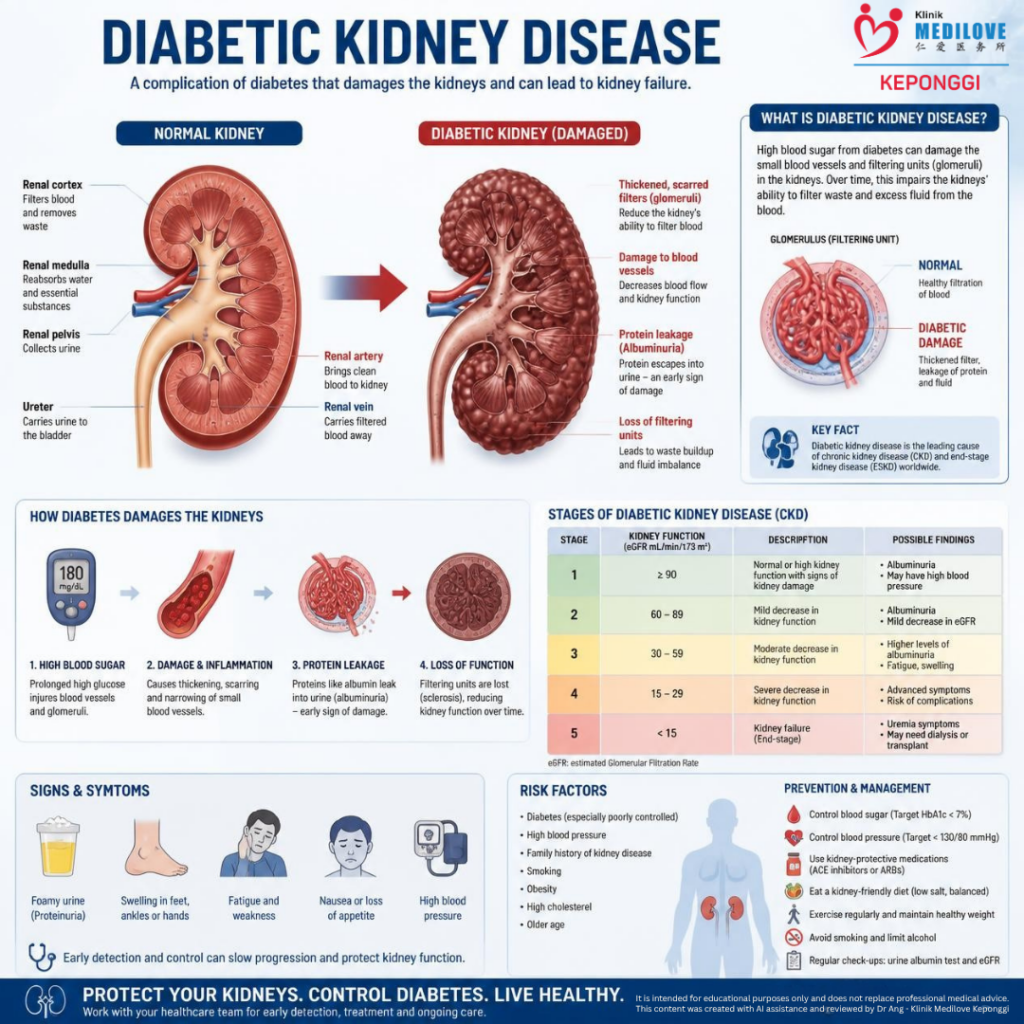
Each kidney contains around a million tiny filtering units. Their job is to let waste and excess water out into your urine while keeping useful things — protein, blood cells — inside your bloodstream. It is a sieve with very fine holes.
Persistently high blood sugar damages the small blood vessels that supply these filters. The same process that harms the vessels behind your eyes and in your feet is happening in your kidneys at the same time. Over years, the sieve becomes leaky and scarred. Protein starts escaping into the urine. Filtering slows down.
High blood pressure accelerates all of it, which is why the two conditions together are so much more dangerous than either alone.
Why you won’t feel anything until it’s late
Here is the part patients find hardest to accept: kidneys do not hurt when they are failing.
You have far more filtering capacity than you need for daily life. You can lose half of it and still feel completely well, pass urine normally, and have a good appetite. There is no ache, no warning twinge, no change you would notice in the mirror.
By the time symptoms appear, function is often already down to a fraction of normal.
The symptoms that do appear — and why they’re late signs
- Swelling of the ankles, feet or around the eyes
- Passing urine more often at night
- Foamy or frothy urine that doesn’t clear
- Persistent tiredness or poor concentration
- Loss of appetite,nausea ,a metallic taste
- Itchy skin
- Breathlessness on mild exertion
If you are experiencing any of these, please get checked soon. But do not wait for them. The whole point of screening is to find the problem years before this list becomes relevant
The two tests that catch it early
Both are simple, quick, and inexpensive. Between them they answer two different questions.
Test 1 – Urine ACR ( Albumin-to- creatinine ratio)
You provide a small urine sample — a first-morning sample is ideal. The lab measures how much albumin (a protein) has escaped into it. A leaky filter shows up here long before your blood results change.
This is the single most useful early-warning test in diabetes, and it is the one most often skipped.
Test 2 – Blood creatinine and eGFR
The question it answers: how well are your kidneys filtering right now?
A blood test measures creatinine, a waste product from your muscles. From that, plus your age and sex, the lab calculates your eGFR — an estimate of your filtering rate as a percentage of normal.
You need both. A person can have a perfectly normal eGFR and a badly abnormal ACR. That person has kidney disease and needs treatment now.
When should I be tested?
- Type 2 diabetes: at the time of diagnosis, then every year
- Type 1 diabetes: starting five years after diagnosis, then every year
- If you already have kidney disease: more often — usually two to four times a year, depending on your stage
- If you have high blood pressure: yearly, even without diabetes
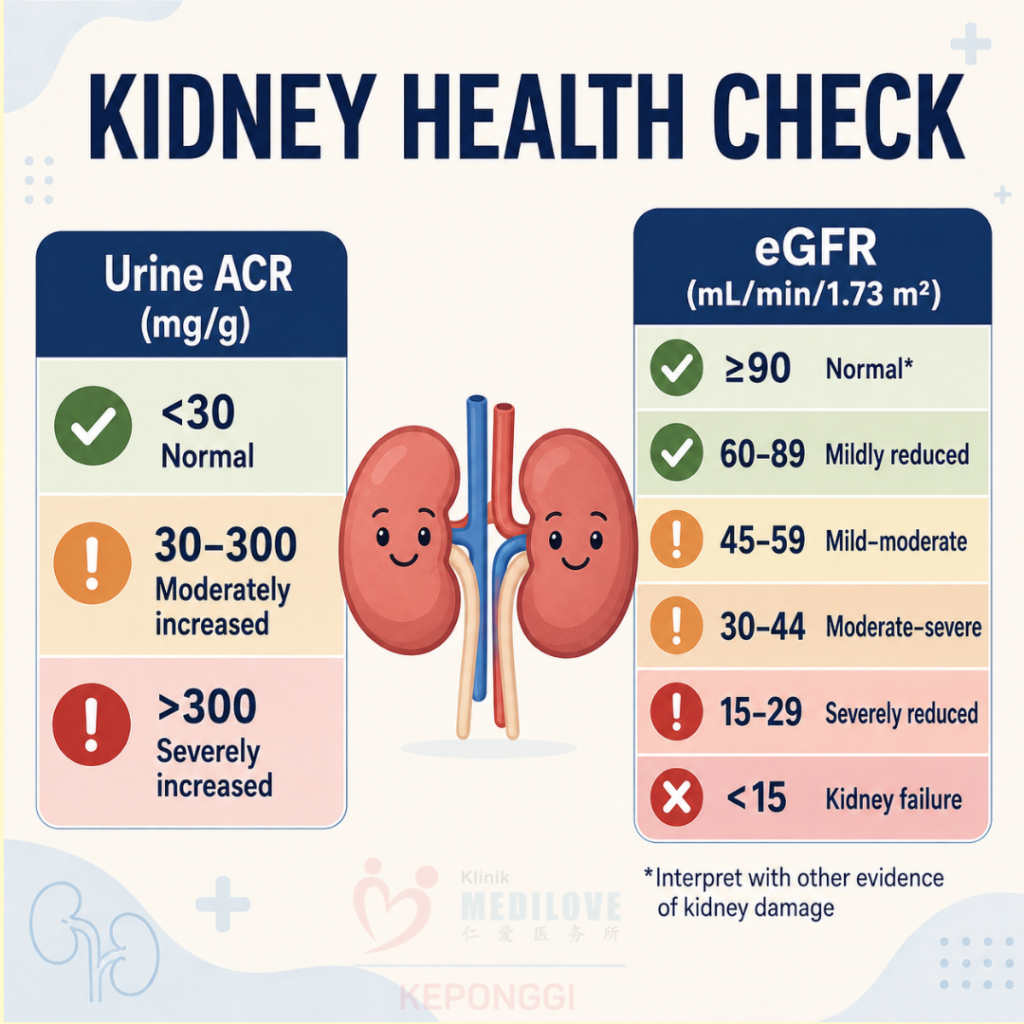
What your numbers mean?
Urine ACR
Under 30 mg/g
30–300 mg/g
Over 300 mg/g
meaning
normal
Moderately increased — early kidney damage
Severely increased — established damage
eGFR
90 and above	        - Normal filtering
60–89	                - Mildly reduced
45–59	               - Mild to moderate reduction
30–44	               - Moderate to severe reduction
15–29	               - Severely reduced
Under 15                - Kidney failure
An abnormal result needs to be repeated and confirmed — a single high ACR can be caused by a urine infection, fever, heavy exercise the day before, or menstruation. We usually confirm on a second sample before making any conclusions. If you’d like to understand exactly what stage your kidneys are at, we’ve written a fuller guide to the five CKD stages.
The good news: early damage can be slowed, and sometimes reversed
This is the message we most want patients to leave with. Diabetic kidney disease found at the ACR stage is not a sentence. Caught early, the leak can be reduced and the decline slowed substantially — in some cases the ACR returns to normal.
Four things drive that.
Blood sugar control
Every point of HbA1c reduction matters, particularly in the first years after diagnosis. Your kidneys carry the memory of your early control for a long time.
Blood pressure — the target is lower than you think
For most people with diabetes and kidney disease, the target is below 130/80 mmHg, not the 140/90 many patients assume is fine. Blood pressure control is at least as important as sugar control for protecting kidneys, and often more so.
Kidney-protective medicines
The last decade has genuinely changed what we can offer. Several classes of medicine now protect kidneys directly, beyond their effect on sugar or blood pressure:
- ACE inhibitors or ARBs — the foundation when there is protein in the urine
- SGLT2 inhibitors — originally diabetes drugs, now among our strongest tools for slowing kidney decline
- Non-steroidal MRAs such as finerenone — added protection where risk stays high
- GLP-1 receptor agonists — useful where cardiovascular risk is also a concern
Which of these suits you depends on your eGFR, your ACR, your other conditions and what you already take. That is a conversation to have with your doctor, not a decision to make from an article.
The everyday habits that matter
- Salt. Aim under one teaspoon a day in total. Most of it is hidden in kicap, sauces, instant noodles, processed meat and kuih — not the salt shaker.
- Painkillers. Regular NSAIDs (ibuprofen, diclofenac, mefenamic acid) are hard on damaged kidneys. Check before using them long-term.
- Traditional and slimming remedies. Some contain substances that are directly toxic to kidneys. Please tell us what you’re taking — we won’t judge, we just need to know.
- Smoking. It accelerates kidney decline independently of everything else.
- Water. Normal thirst-driven intake is right. Neither dehydration nor forcing litres of water helps.
When you need a kidney specialist
We would generally refer you to a nephrologist if your eGFR falls below 30, if it is below 60 with significant protein in the urine, if your function is dropping quickly, or if there is blood in the urine that has no clear explanation. Referral is not a sign that things have gone wrong — earlier specialist input generally means better outcomes.
Getting checked at Medilove Keponggi
If you have diabetes and cannot remember your last urine ACR, that is reason enough to come in. Both tests can be done in one visit, and kidney function is included in a screening package that covers your other diabetes-related risks at the same time.
Walk in during opening hours, or WhatsApp us at wa.link/i8asmp to arrange a time.
Klinik Medilove Keponggi Lot C, Keponggi, 08-G, Jalan Rimbunan Teratai 1, Kepong, 52100 Kuala Lumpur Mon–Fri 8:00am–9:00pm · Sat–Sun 8:00am–3:00pm · +6011-1560 7148
Frequently asked questions
Can diabetic kidney disease be reversed? Early damage — the stage where protein is leaking but filtering is still good — can often be improved and sometimes normalised with treatment. Scarring that has already formed cannot be undone, which is exactly why finding it early matters so much.
I feel completely fine. Do I still need the test? Yes. Feeling fine is the normal state for early kidney disease. In the Malaysian study above, 95% of people found to have CKD had no idea.
Does having protein in my urine mean I’ll need dialysis? No. Most people with early albuminuria never reach dialysis, particularly with good blood pressure control and kidney-protective treatment. It is a signal to act, not a prediction.
Will I have to stop eating protein? Not in early disease. Very high protein intake isn’t helpful, but restricting protein is only appropriate at advanced stages and should be supervised — unnecessary restriction causes malnutrition.
How much does the test cost? Both tests are inexpensive and are included in our screening packages. Please ask us or WhatsApp for current pricing.
My sugar is well controlled. Am I safe? Good control lowers your risk considerably, but does not remove it. Blood pressure, duration of diabetes, family history and other factors all contribute — which is why annual screening applies to everyone with diabetes.
Reviewed by Dr Ang · Klinik Medilove Keponggi