







Pap smear: what to expect and how to prepare.
Pap smear preparation made easy: a step-by-step guide for women who feel nervous about the test, especially if it is your first time. The test takes less than 5 minutes, and you can ask us to stop at any time.
What is a Pap smear?
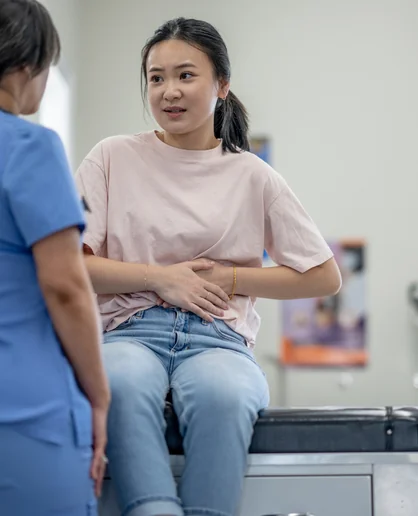
A quick check of the health of your cervix, for women aged 20 to 65 who have ever been sexually active.
Many women put the test off because they feel nervous or embarrassed. Knowing exactly what happens, and simple Pap smear preparation, usually makes it much easier. This guide explains how to prepare for a Pap smear and what happens during a Pap smear, step by step.
Your cervix is the opening of your womb at the top of your vagina. In a Pap smear, a doctor or nurse takes a small sample of cells from your cervix. A laboratory then checks the cells for early changes.
Good to know: a Pap smear is a screening test, not a test for cancer. It aims to find changes early, often years before they could turn into cancer, so they can be treated.
Pap smear or HPV test: which one?
Your doctor will help you choose the test that suits your age and history.
Most cervical cancers are caused by a long-lasting infection with high-risk types of human papillomavirus (HPV), a common virus passed on through sexual contact.
Checks for the virus itself. Malaysia’s Ministry of Health (MOH) recommends it for sexually active women aged 30 to 65.
Checks the cells under a microscope. MOH guidance says women under 30 can be offered it.
For the full comparison, see our guide Pap Smear or HPV Test? Cervical Screening in Malaysia.
Pap smear preparation: how to get ready
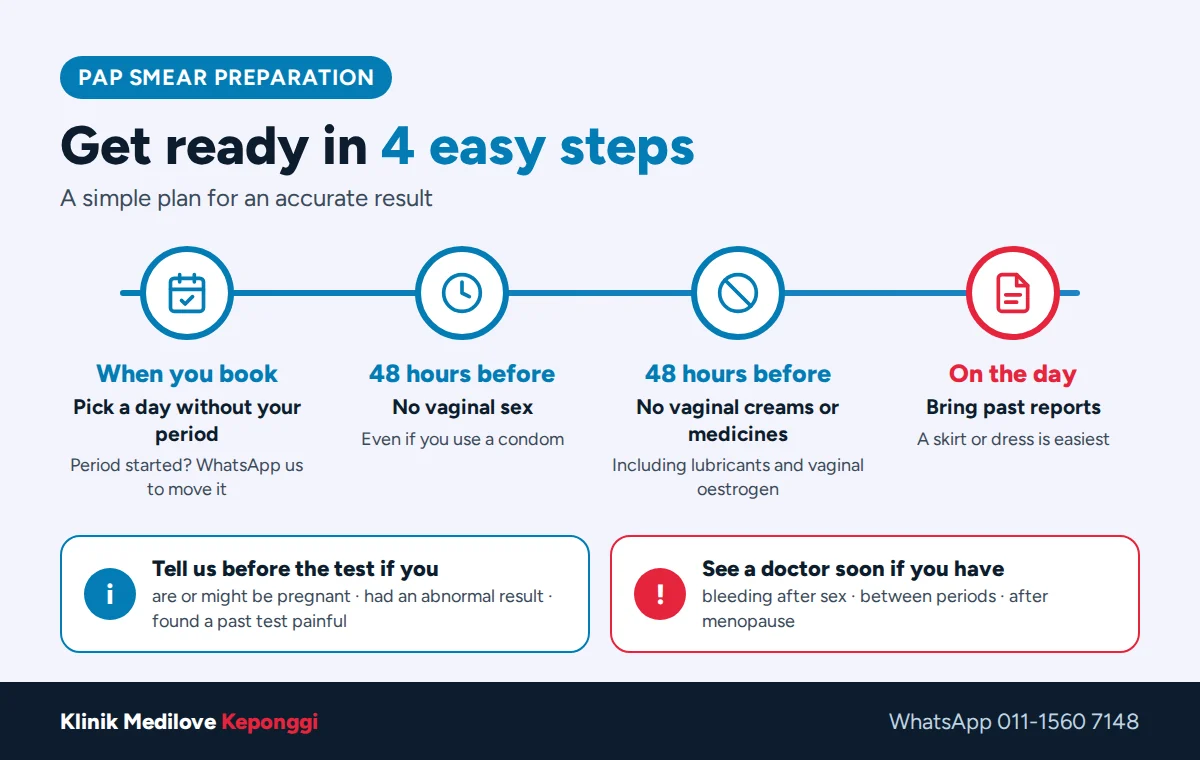
Good Pap smear preparation helps your sample give a clear, accurate result.
When you book
Choose a day when you will not have your period. If your period starts unexpectedly, WhatsApp us to change the date.
2 days (48 hours) before
This is the most important part of Pap smear preparation. Do not have vaginal sex, even with a condom, and do not use vaginal creams, moisturisers, lubricants or vaginal medicines, including vaginal oestrogen. These can affect the sample.
On the day
Wear a skirt or dress if you like — you can usually keep it on. Bring any previous Pap smear or HPV reports. You are welcome to bring someone you trust.
Tell us before the test
As part of your Pap smear preparation, tell us if you are or might be pregnant, had an abnormal result before, found a previous test painful or have vaginal dryness (we can use a smaller speculum or give you more time), or have any of the symptoms listed below.
What happens during a Pap smear
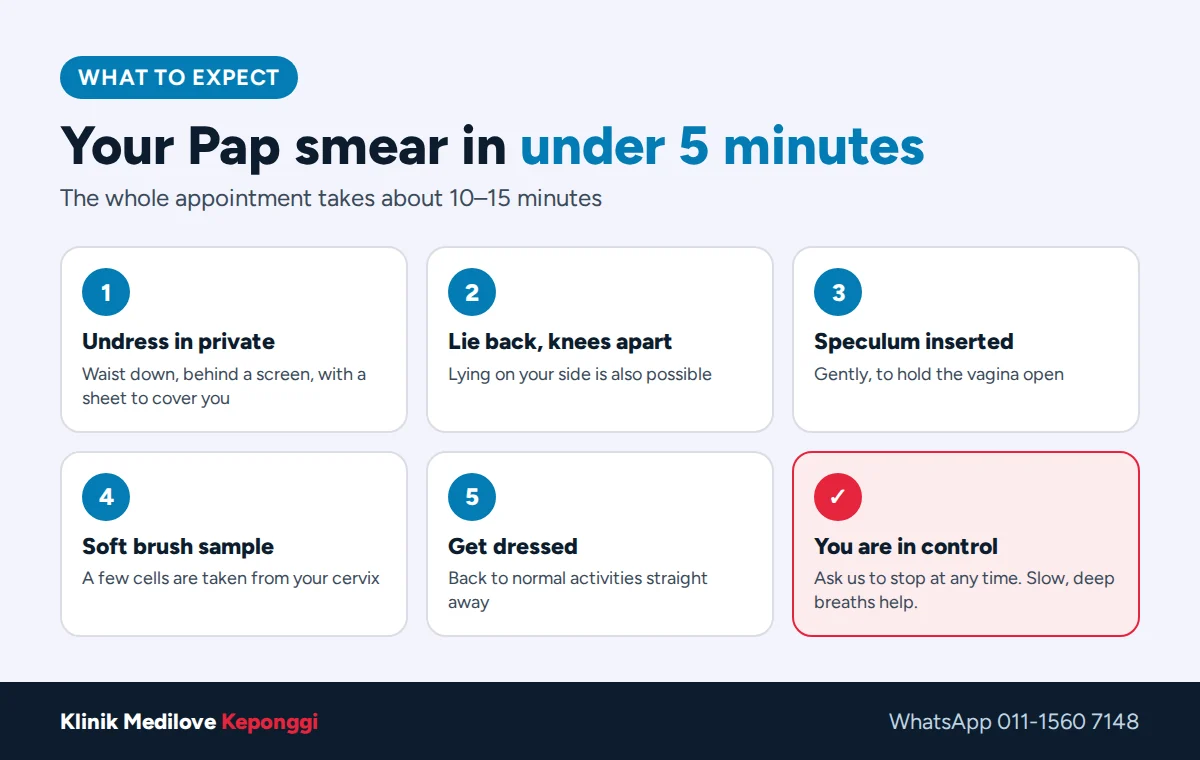
Here is what happens during a Pap smear, step by step. The test itself takes less than 5 minutes; the whole appointment takes about 10 to 15 minutes.
- 1
Undress in private
You undress from the waist down behind a screen and cover yourself with a sheet.
- 2
Get comfortable
You lie on your back with your knees bent and apart. Lying on your side is also possible.
- 3
Speculum
The doctor gently inserts a speculum, a smooth, tube-shaped instrument that holds the vagina open.
- 4
Sample
They use a soft brush to take a small sample of cells from your cervix.
- 5
Get dressed
They remove the speculum and leave you to get dressed.
You are in control. You can ask us to stop at any time. Most women find it slightly uncomfortable rather than painful. Slow, deep breaths help.
After the test and your results
You can go back to your normal activities straight away.
Light spotting is common and should stop within a few hours. Results usually take 5 to 7 days. We will contact you and go through them with you.
No changes were found this time. It does not mean you never need another test.
This does not mean you have cancer. Most changes are early and treatable. You may need a repeat test or a colposcopy — a closer look at the cervix with a magnifying instrument.
See a doctor if you have heavy bleeding, or spotting that does not stop after a few hours.
How often? If your HPV test is negative, MOH recommends testing again in 5 years. For other results, your doctor will tell you when your next test is due.
Don’t wait for screening if you have symptoms
See a doctor soon, even after a recent normal test, if you have bleeding after sex, bleeding between periods or bleeding after menopause.
Pap smear preparation FAQ
Quick answers to common Pap smear preparation questions from our patients in Kepong.
How should I prepare for a Pap smear?
Book a day when you will not have your period. For 48 hours before, avoid vaginal sex (even with a condom) and do not use vaginal creams, lubricants or vaginal medicines. On the day, bring any previous Pap smear or HPV reports.
Does a Pap smear hurt?
Usually not. Most women feel mild discomfort for a minute or two. Tell us if it hurts, and we can adjust.
Can I do a Pap smear during my period?
No. Please book a day when you are not having your period. If your period starts unexpectedly, WhatsApp us to change the date.
I’m pregnant. Should I still have it?
Usually not. Routine screening is normally postponed until about 12 weeks after the birth. If you had an abnormal result before, talk to your doctor.
I had sex last night. Is that a problem?
Yes. Avoid vaginal sex for 48 hours before a Pap smear, even if you used a condom, as it can affect the sample. WhatsApp us and we will help you move your appointment.
I have never had sex. Do I need a Pap smear?
Your risk is very low, but not zero, because HPV can spread through any sexual contact. Talk to your doctor to decide.
How often do I need a Pap smear?
If your HPV test is negative, the Ministry of Health recommends testing again in 5 years. For other results, your doctor will tell you when your next test is due.
Do I need to fast before a Pap smear?
No. Fasting is not part of Pap smear preparation, so you can eat and drink normally. You only need to fast if your Pap smear is part of a health screening package that includes fasting blood tests, such as blood sugar or cholesterol.
I have had the HPV vaccine. Do I still need screening?
Yes. The vaccine protects against the most common high-risk HPV types, but not all of them. Keep having regular cervical screening as advised by your doctor.
I have passed menopause. Do I still need a Pap smear?
Yes, screening is recommended up to age 65, and Pap smear preparation is the same as before menopause. Tell us if you have vaginal dryness or discomfort, as we can use a smaller speculum and take more time.
What if I have unusual discharge or a vaginal infection?
Tell us before the test. An infection can make the sample harder to read, so your doctor may treat it first and book your Pap smear once it has cleared.
When is the best time in my cycle for a Pap smear?
For Pap smear preparation, the ideal time is about 10 to 20 days after the first day of your last period, when you are not bleeding. If your cycle is irregular, simply choose a day without any bleeding.
Is a Pap smear included in your health screening packages?
Yes. A Pap smear is part of our women’s health screening packages (MediLady and MediLady+), and of MediSaver for women. See our health screening packages, or ask us if you would like it as a single test.
Can I choose a female doctor?
Yes, a female doctor is available. Please ask us to confirm when you book.
Sources
- Guidelines for Cervical Cancer Screening in Malaysia 2023. Ministry of Health Malaysia, 2023.
- Guidelines for Primary HPV Testing in Cervical Cancer Screening in Malaysia. Family Health Development Division, MOH Malaysia, 2019.
- New recommendations for screening and treatment to prevent cervical cancer. World Health Organization, 2021.
- What happens at your cervical screening appointment. NHS, 2023.
- Preparing for your cervical screening appointment. HSE Ireland.
- Having a cervical screening test – FAQs. Public Health Wales.

Questions about your Pap smear?
Our team is happy to help with your Pap smear preparation — just WhatsApp or call us.
Find usLot C-08-G (ground floor), KepongGi, Jalan Rimbunan Teratai 1, 52100 Kepong, Kuala Lumpur
KepongGi Square · beside Taman Metropolitan Kepong
Phone / WhatsApp011-1560 7148
Opening hoursMon–Fri 8:00 am – 9:00 pm
Sat–Sun 8:00 am – 6:00 pm
Last reviewed: 1 October 2026. This page gives general information and does not replace advice from your doctor. If your doctor gives you different instructions, follow your doctor.