









Pap Smear or HPV Test? What Cervical Screening Looks Like in Malaysia Now
If the last thing you remember about cervical screening is lying on a couch with a speculum and hoping it would be over quickly, there is something you should know: the test has changed.
Malaysia has moved to using the HPV test as the first-line screening test for most women. It is more sensitive than the Pap smear, it is needed less often, and for many women it can be done with a swab you insert yourself. If you have been putting this off for years — and a lot of our patients in Kepong have — this is a good moment to reconsider.
Why cervical cancer is still worth your two minutes
Cervical cancer remains one of the most common cancers affecting Malaysian women, and one of the very few we know how to prevent almost entirely. It is caused by persistent infection with high-risk types of the human papillomavirus (HPV). The infection is common and usually clears on its own; in a minority of women it lingers, quietly changes the cells of the cervix over ten to fifteen years, and only then becomes cancer.
That long, silent window is the whole opportunity. Screening finds the changes while they are still easy to treat — before any symptoms appear. By the time there is bleeding after intercourse, bleeding between periods, or an unusual discharge, we are already later in the story than anyone wants to be.
The big change: the HPV test now comes first
Malaysian guidance now recommends primary HPV testing rather than starting with cytology for the main screening age group.
Pap smear (cytology) is still the recommended test in this age group. HPV infection is very common in your twenties and usually clears without doing any harm, so testing for it here would flag a lot of women unnecessarily.
You should have an HPV test every 5 years if the result is negative — replacing the older habit of an annual or three-yearly Pap smear. Five years worries some women, but the HPV test looks for the cause rather than the consequence, so a negative result is reassuring for far longer than a normal Pap smear ever was
Pap smear remains the recommended approach in current Malaysian guidance. If you are past 50 and have never been screened, please do not decide you have missed the boat — come and talk to us.
If you have had abnormal results in the past, the rules above are a starting point rather than the final answer; your own history changes the plan.
HPV test vs Pap smear — what’s actually different
Both start the same way: a sample of cells from the cervix or upper vagina. What happens in the laboratory is different.
A Pap smear asks: have the cells already started to look abnormal? It is a snapshot of damage that has begun. An HPV test asks: is the virus that causes that damage present at all? That is an earlier question, and a more sensitive one — which is why a negative HPV test buys you five years of confidence while a normal Pap smear did not.
The two also work together. If your HPV test is positive, the same sample can often be used for cytology — a reflex test that tells us how urgently you need to be seen.
You can collect the sample yourself
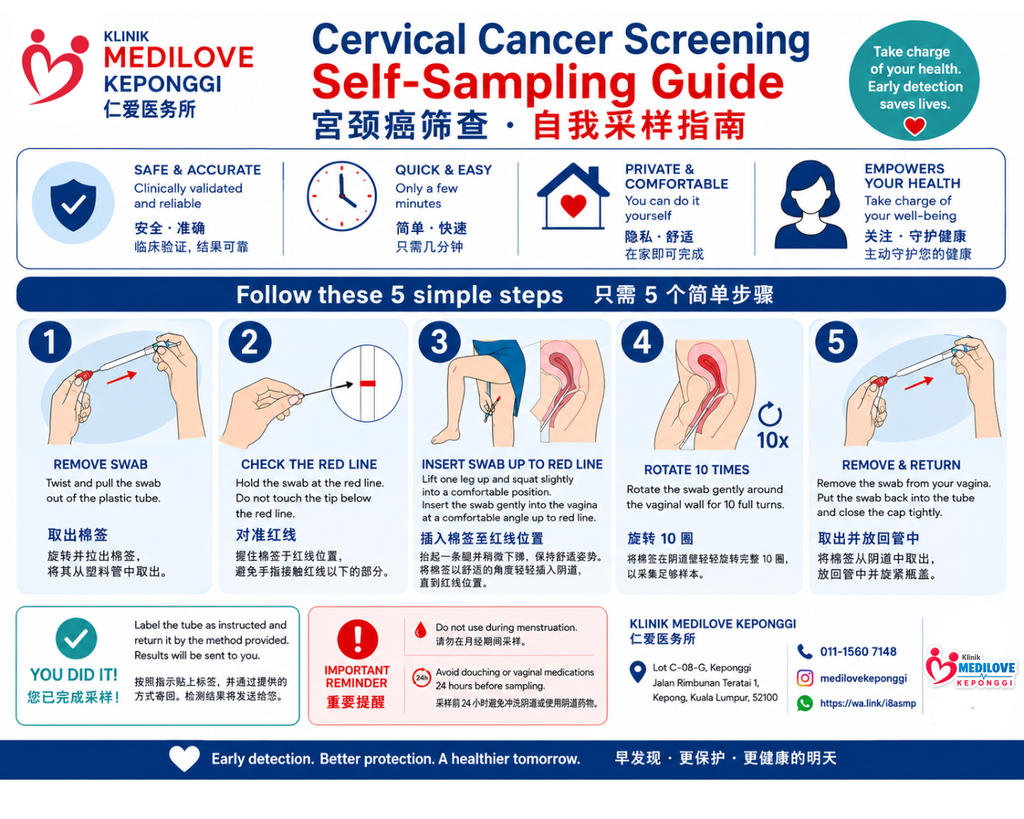
This is the part that changes minds. Under the primary HPV testing approach, the sample can be taken by self-sampling: you use a soft flocked swab, insert it to a marked depth, rotate it, and place it into the preservative tube. No speculum. No stirrups. You do it privately, in a few minutes. For women who feel unsure, a clinician can collect the sample with the same kit — still without a speculum.
Self-sampling was pioneered in Malaysia partly through Program ROSE, and it exists for exactly the reason you are probably thinking: embarrassment and discomfort were keeping women away from a test that saves lives. Now you can’t give excuses like the speculum or the male doctor, those days are gone.
Free or subsidised HPV DNA testing has been made available to eligible Malaysian women through LPPKN and Klinik Nur Sejahtera. Do check the current arrangements, as eligibility changes from year to year.
If cost is the obstacle, free or subsidised HPV DNA testing has been made available to eligible Malaysian women through LPPKN’s Klinik Nur Sejahtera.
There is one Klinik Nur Sejahtera LPPKN Kepong in Kepong, a few minutes from us:
Klinik Nur Sejahtera LPPKN Kepong | No. 12-1, Jalan Metro Perdana 8, Taman Usahawan Kepong, 52000 Kepong Utara, Kuala Lumpur |
📞 03-6250 0670 · Map
Please call ahead to confirm eligibility, current availability and whether you need an appointment — programme details change from year to year. We would genuinely rather you were screened there for free than not screened at all.
What happens if the HPV test is positive?
First, breathe. A positive result means the virus is present. It does not mean you have cancer, and in most women it does not mean you ever will. It means we now follow up properly instead of guessing.
If HPV 16 or 18 is found
These two types cause the majority of cervical cancers, so a positive result for either is taken seriously: you will be referred for colposcopy, a closer look at the cervix with a magnifying instrument. It is an outpatient examination, not surgery.
If another high-risk HPV type is found
The sample goes for reflex cytology. If the cells look normal, or show only minor changes, the usual plan is to repeat the HPV test in a year — many infections clear on their own in that time. If the cells show more significant changes, you are referred for colposcopy.
An unsatisfactory or inconclusive sample simply means the test is repeated. It is not a bad sign.
“I had the HPV vaccine — do I still need screening?”
Yes. The vaccine is excellent, and Malaysia’s school-based programme for 13-year-old girls has had high uptake — but it does not cover every high-risk HPV type, and many women were vaccinated after they had already been exposed. Vaccination and screening are partners, not alternatives.
If your daughter is in Form 1, the vaccination is offered through school. If she missed it, please ask about catch-up.
The four reasons women in Kepong tell us they haven’t gone yet
“It’s embarrassing.” Self-sampling removes the speculum entirely. You can request a female staff member.
“I have no symptoms, so I must be fine.” Early cervical changes have no symptoms at all. That is the point of screening.
“I’m not sexually active anymore.” HPV can persist for years after exposure. Past exposure is what matters, not current activity.
“I don’t have time.” The self-collected sample takes a few minutes. Many women fold it into a wider women’s health screening or full body screening package so it is one visit, not two.
Getting screened at Klinik Medilove Keponggi
We offer cervical screening as part of our women’s health screening service. Book a standalone HPV test, or include it in a broader package alongside blood pressure, blood sugar, cholesterol and, where relevant, breast examination.
Klinik Medilove Keponggi 仁爱医务所
Lot C, Keponggi, 08-G, Jalan Rimbunan Teratai 1, Kepong, 52100 Kuala Lumpur
📞 +6011-1560 7148 · WhatsApp: https://wa.link/i8asmp
Open Mon–Fri 8:00am–9:00pm · Sat–Sun 8:00am–3:00pm
Current our PAP Smear + HPV testing: RM 280.
It is inclusive in part of the women’s health screening package.