









Good weight management is not simply “eat less and exercise more” — and it is not simply a weight-loss injection. It starts by understanding your weight story, where excess fat is stored, whether it is affecting your health, and which treatment is realistic for you.
This article incorporates the ADA’s 2026 standards on screening, diagnosis, evaluation and staging of adult obesity, together with its 2026 diabetes weight-management recommendations. Diabetes-specific recommendations are identified as such.
If you have tried to lose weight before, you probably already know the usual advice: cut rice, stop supper, exercise more, avoid sugar.
Those changes can help. But they do not explain why one person feels satisfied after a meal while another remains hungry; why someone gains weight after starting a medicine or changing to shift work; why weight comes back after a successful diet; or why two people with the same BMI can have very different health risks.
Medical weight management takes a broader approach.
Instead of asking only “How do we make the number on the scale smaller?”, we ask: “What is driving this person’s weight, what is it doing to their health, and what treatment intensity fits them?”
1. Medical weight management starts with respect
Weight can be a sensitive health issue. The 2026 ADA obesity standard recommends your doctor asking permission before discussing weight, using person-centred language and reducing weight stigma during assessment.
A useful clinical framework is the 6As:
Is it okay if we discuss your weight and how it may relate to your health?
Measure adiposity, understand the weight history and look for obesity-related complications and contributing factors.
Explain what the findings mean and how different degrees of weight loss may affect health.
Set goals together based on health priorities, readiness, preferences and what feels realistic.
Choose appropriate nutrition, activity, behavioural, medication or referral support.
Plan follow-up rather than treating weight management as a one-off visit.
2. BMI is useful — but it is not the whole diagnosis
BMI remains a practical screening tool because it is easy to measure. However, BMI does not directly show body-fat distribution, muscle mass or the amount of visceral fat around the abdominal organs.
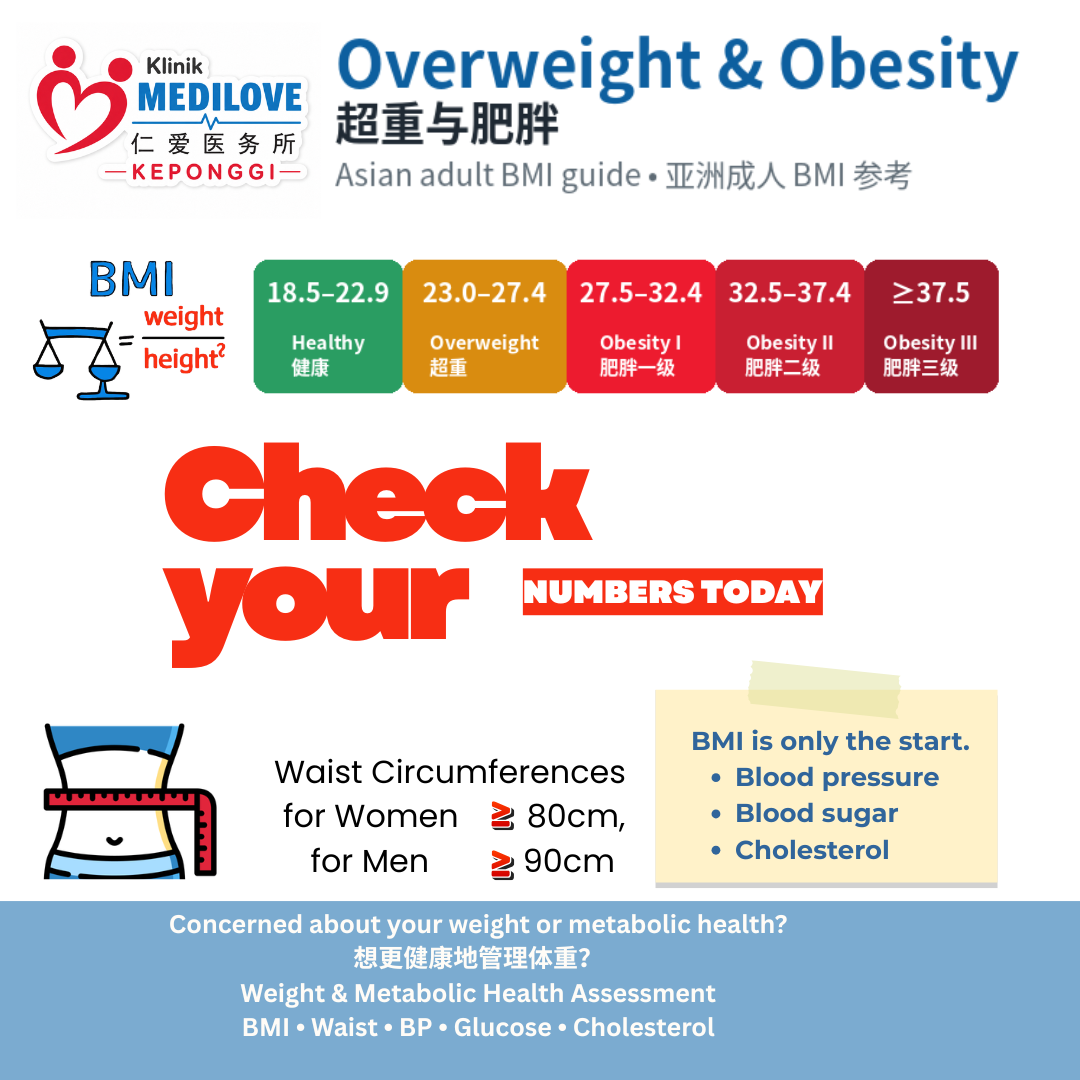
This matters in Asian populations because excess adiposity and cardiometabolic risk may occur at lower BMI levels.
- Screen for excess adiposity from BMI ≥23 kg/m².
- Diagnose obesity if BMI ≥27.5 kg/m²; or
- if BMI is 23–27.4 kg/m² and waist-to-height ratio ≥0.5; or
- if BMI is 23–27.4 kg/m² and waist circumference is ≥80 cm in women or ≥90 cm in men.
These are ADA general thresholds for people with an Asian background. Clinical interpretation should still consider local guidance and the individual patient.
What is waist-to-height ratio?
Waist-to-height ratio (WHtR) is simply:
waist circumference ÷ height
For example, a waist of 85 cm at a height of 165 cm gives a WHtR of 0.52. In the ADA 2026 framework, a ratio of 0.5 or above is used as a marker of central adiposity when BMI is in the intermediate range.
Quick BMI & waist-to-height check
3. Your weight trend can matter before a BMI threshold is crossed
The ADA recommends monitoring BMI at least annually. It also highlights the importance of consistent weight gain over time. A persistent increase of about 1–1.5 kg per year for more than three years may signal higher future risk and should prompt a closer look at contributing factors.
This is why your doctor may ask:
- What was your weight five or ten years ago?
- When did the increase begin?
- Was there a pregnancy, injury, stressful job, bereavement, medication change or change in working hours?
- What was your highest adult weight?
- What approaches helped you lose weight before?
- What made previous plans difficult to continue?
4. We should not order every “hormone test” for everyone
Weight gain can occasionally be related to a secondary medical cause. However, the ADA guidance does not recommend indiscriminate testing for every possible endocrine disorder in every patient.
Testing should be guided by the history and examination. For example, thyroid testing is reasonable when symptoms suggest hypothyroidism; further endocrine testing may be considered when the clinical picture suggests disorders such as hypercortisolism or PCOS.
That is one difference between medical assessment and a generic “weight-loss blood package”: each test should answer a clinical question.
5. After diagnosis, the important question is: how much is weight affecting your health?
Two patients with the same BMI can have very different disease severity.
The 2026 ADA standard recommends a comprehensive evaluation after overweight or obesity is diagnosed. This includes weight history, contributing factors, previous treatments, barriers, obesity-related diseases, psychological health, support systems, and social factors that may affect treatment.
The ADA also recommends considering the Edmonton Obesity Staging System (EOSS) to help describe the burden of obesity-related disease and functional impairment.
This is why we should not treat a BMI number in isolation.
6. What do we actually look for during a medical weight assessment?
| Domain | Examples of what may be assessed |
|---|---|
| Weight story | Weight trajectory, highest and lowest adult weight, age of onset, family history, previous treatment and response. |
| Eating pattern | Typical day, portions, drinks, snacking, hunger, cravings, night eating, binge-type symptoms and cultural food preferences. |
| Movement | Exercise, walking, sedentary time, physical limitations and what activities are realistic or enjoyable. |
| Sleep & stress | Sleep duration and quality, night-shift work, daytime sleepiness, stress and coping. |
| Medication | Current medicines, supplements and whether any treatment may promote weight gain. |
| Metabolic health | Prediabetes/diabetes, blood pressure, lipids, fatty-liver risk and cardiovascular disease where relevant. |
| Other complications | Sleep apnoea, osteoarthritis, reflux, PCOS, urinary symptoms, mobility and other obesity-related conditions. |
| Mental health | Depression, anxiety, disordered eating and previous experiences of weight stigma where relevant. |
| Practical barriers | Work hours, food access, family support, finances, treatment cost, transport and ability to attend follow-up. |
7. The goal is better health — not automatically your lowest-ever weight
The ADA obesity standard specifically emphasises collaborative goals that produce clinically meaningful health and quality-of-life benefits. Returning to the lowest weight you ever had as an adult is not necessarily the right target.
A useful first goal may be to improve:
- glucose or HbA1c;
- blood pressure;
- waist circumference;
- fatty-liver risk;
- sleep apnoea symptoms;
- mobility, fitness or joint pain;
- energy and day-to-day function.
The percentages above are particularly supported in populations with prediabetes or type 2 diabetes; an individual’s target should be based on their conditions, treatment options and goals.
Have prediabetes? See Can You Reverse Prediabetes? 4 steps for Malaysians.
8. A personalised nutrition plan should fit Malaysian life
No single macronutrient pattern is best for everybody. The ADA diabetes standard recommends individualising nutrition according to preferences and nutritional needs while creating an energy deficit when weight loss is the goal.
For a Malaysian patient, the useful question is often not “Can I ever eat rice again?” but:
Which part of my usual eating pattern is contributing most to excess energy intake — and which change can I actually maintain?
| Usual situation | A more sustainable starting point |
|---|---|
| Teh tarik / kopi ais more than once daily | Reduce sweetness and frequency; make water or unsweetened drinks the default more often. |
| Mixed rice with a large rice portion | Keep vegetables and a protein source; reduce the rice portion rather than banning rice completely. |
| Nasi lemak + fried side + sweet drink | Look at the combination: portion size, additional fried food and sugary drinks can be adjusted separately. |
| Late-night mamak after work | First identify whether this is physical hunger, a social habit, shift-work routine or stress-related eating. |
| Very strict weekday dieting followed by weekend overeating | A less restrictive pattern that can be repeated seven days a week may be more sustainable. |
9. Physical activity is treatment — not punishment for eating
Physical activity improves health even when the scale changes slowly. The ADA recommends encouraging activities a person can enjoy and build toward about 150 minutes per week for general health.
During active weight loss, preserving lean mass matters too. The ADA diabetes standard highlights adequate protein intake together with resistance training to help preserve lean mass.
So the question is not simply “How many calories did I burn?” It is also:
- Am I fitter?
- Am I stronger?
- Can I walk further?
- Am I protecting muscle while losing excess fat?
10. Weight-loss medication is one tool — not the whole programme
Medication can be appropriate for selected patients, but good medical weight management does not begin with choosing an injection.
If you are weighing up an injection, read our guide on when a GLP-1 weight-loss injection is worth considering.
It begins with diagnosis, complications, goals, previous treatment, contraindications, preferences, affordability and the likelihood that treatment can be continued.
For people with type 2 diabetes and overweight or obesity, the ADA diabetes standard recommends considering obesity pharmacotherapy alongside lifestyle treatment. It also advises individualising the dose and titration to balance effectiveness, health benefit and tolerability — the best dose is not automatically the maximum dose.
The ADA diabetes standard recommends continuing chronic obesity pharmacotherapy beyond achievement of weight goals when appropriate, because discontinuation often results in weight recurrence and loss of cardiometabolic benefits. It cites trials in which abrupt discontinuation of semaglutide or tirzepatide was followed by regain of roughly one-half to two-thirds of the lost weight within one year.
This does not mean everyone must remain on medication forever. It means the question “What is our maintenance plan?” should be discussed before treatment is stopped.
11. Follow-up is part of the treatment
Obesity is a chronic, often relapsing condition. A one-off consultation or one box of medication is not a complete management programme.
For people with diabetes starting obesity pharmacotherapy, the ADA 2026 standard recommends assessing effectiveness and safety at least monthly for the first three months and at least quarterly thereafter. The exact follow-up schedule for any individual should be tailored to their treatment, risks and clinical response.
If treatment is not working, the response should not simply be “try harder”. We reassess:
- Is hunger still uncontrolled?
- Has the eating pattern changed?
- Are adverse effects limiting treatment?
- Is sleep or stress undermining progress?
- Is a medication promoting weight gain?
- Is the plan too expensive or complicated?
- Has the patient’s health goal changed?
12. What personalised medical weight management can look like at Klinik Medilove Keponggi
Why are you seeking help now? Diabetes risk? Fatty liver? Fertility? Mobility? Appearance? Hunger? Repeated regain?
Weight trajectory, BMI, waist circumference and, where useful, waist-to-height ratio.
Blood pressure, metabolic risk and symptoms of obesity-related complications; targeted laboratory or diagnostic testing where clinically indicated.
Eating pattern, hunger, work routine, activity, sleep, stress, medications, previous attempts and barriers.
Not just “What is the BMI?” but “What complications and functional effects are already present?”
Nutrition, physical activity, behavioural support, medication when appropriate, and referral for specialist or metabolic-surgical assessment when indicated.
Track health outcomes, treatment tolerance and sustainability — then adjust when needed.
To see how this works at our clinic, read Medical Weight Management in Kepong: More Than Dieting, More Than Injections.
13. What should I bring to my first weight-management consultation?
You do not need to prepare a perfect food diary. Helpful information includes:
- your current medication and supplement list;
- recent blood-test results if available;
- roughly how your weight has changed over the last few years;
- what you have tried previously and what happened;
- a description of a typical workday’s meals, drinks and sleep;
- your main health goal and what you are most worried about.
Sometimes the most valuable first visit ends without a prescription. The first task may simply be to answer:
What is driving my weight, what is it doing to my health, and what should we tackle first?
Thinking about medical weight management?
If your weight or waist has been increasing, you have repeatedly lost and regained weight, or you are considering weight-management medication, a structured assessment can help determine what level of treatment is appropriate for you.
Klinik Medilove Keponggi (仁爱医务所), Kepong
WhatsApp / Tel: 011-1560 7148
Monday–Friday: 8am–9pm
Saturday–Sunday: 8am–3pm
References
- American Diabetes Association Professional Practice Committee for Obesity. Screening, Diagnosis, Evaluation, and Staging of Obesity in Adults: Standards of Care in Overweight and Obesity—2026. Diabetes, Obesity, and CardioMetabolic CARE. 2026;1:536–571. doi:10.2337/doci26-0003.
- American Diabetes Association Professional Practice Committee for Diabetes. 8. Obesity and Weight Management for the Prevention and Treatment of Diabetes: Standards of Care in Diabetes—2026. Diabetes Care. 2026;49(Suppl 1):S166–S182. doi:10.2337/dc26-S008.