








If a screening report has come back with “prediabetes” written on it, the next question is : can you reverse prediabetes, or has diabetes already been decided? For many people the numbers genuinely can be brought back into the normal range, and even when they cannot, the chance of going on to develop type 2 diabetes can be cut substantially.
Can You Reverse Prediabetes? 4 steps for Malaysians

What prediabetes actually means
Prediabetes is not a mild form of diabetes, and it is not really a disease in its own right. It is a description: your blood sugar is higher than normal, but not high enough to meet the threshold for diabetes. Your body is still making insulin — it is simply having to work harder, and your cells are responding to it less well than they used to.
What makes it worth taking seriously is that it rarely presents alone. Raised blood pressure, an unhelpful cholesterol pattern and extra weight around the middle tend to be an issue as well, which is why your doctor will usually want to look at all of them together rather than at the sugar reading by itself.
The numbers Malaysia uses
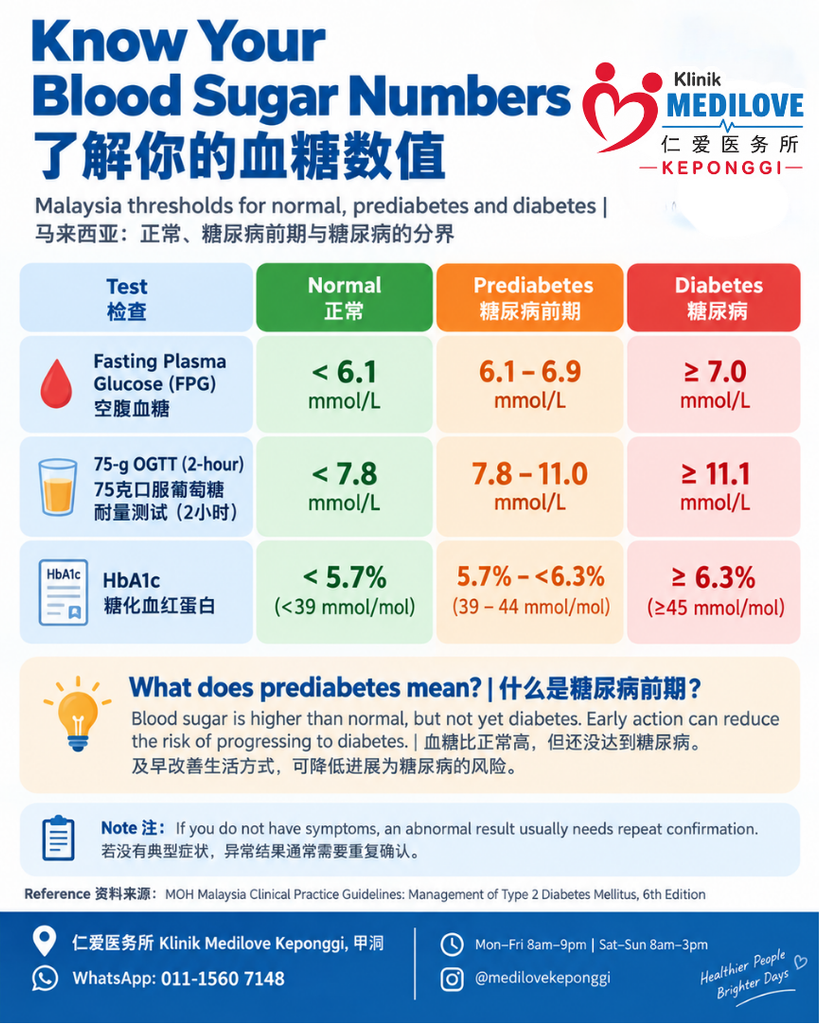
| Test | Normal | Prediabetes | Diabetes |
|---|---|---|---|
| Fasting plasma glucose | below 6.1 mmol/L | 6.1 – 6.9 mmol/L | 7.0 mmol/L or above |
| 2-hour glucose (75 g OGTT) | below 7.8 mmol/L | 7.8 – 11.0 mmol/L | 11.1 mmol/L or above |
| HbA1c | below 5.7% (below 39 mmol/mol) | 5.7 – 6.2% (39–44 mmol/mol) | 6.3% or above (45 mmol/mol or above) |
Two terms you may see on the report. Impaired fasting glucose (IFG) means the fasting reading is in that middle band. Impaired glucose tolerance (IGT) means the two-hour reading after a glucose drink is in its middle band. You can have one without the other, and the OGTT is the only test that can find IGT.
Why your result may not match what you read online
This trips up a lot of people who go looking for their number on the internet.
- Malaysia calls it diabetes at an HbA1c of 6.3%. American guidance draws that line at 6.5%, and counts 5.7–6.4% as prediabetes.
- Malaysia’s fasting prediabetes band starts at 6.1 mmol/L. American guidance starts it at 5.6 mmol/L (100 mg/dL).
So an HbA1c of 6.4% is in the diabetes range under the guideline your Malaysian doctor is using, while a US website will reassure you that it is only prediabetes. Going the other way, a fasting glucose of 5.8 mmol/L is normal here but “prediabetes” there.
Go by the guideline your doctor is working from. And either way, a number sitting near a cut-off is a reason to do something, not a reason to argue about where the line belongs.
Can you reverse prediabetes — and what does “reversed” mean?
It helps to separate two quite different claims.
The first is that the numbers can come back into the normal range. That happens often. In a Malaysian expert review of the evidence, about 32% of people with isolated impaired glucose tolerance returned to normal glucose tolerance with lifestyle change.
The second is that the risk is then gone for good. That one is not true, and it is worth knowing before you start.
The large prevention trials are where the honest numbers live. In the Diabetes Prevention Program, people with prediabetes who aimed for 7% weight loss and 150 minutes of moderate activity a week were 58% less likely to develop type 2 diabetes over about three years than people given placebo. In participants aged 60 and over the reduction was 71%. Metformin, for comparison, gave a 31% reduction.
Then the follow-up. Fifteen years on, the lifestyle group still had a 27% lower rate — real, durable benefit, but a delay rather than an abolition. Most participants in every group, including the lifestyle group, eventually developed diabetes. Left alone, roughly 5–10% of people with impaired glucose tolerance develop diabetes each year, and up to about 70% eventually do.
The sensible reading: to reverse prediabetes means getting back into the normal range, and still testing every year. That is a good outcome, not a discharge.
Prediabetes · Evidence
Can lifestyle change really prevent type 2 diabetes?
What the Diabetes Prevention Program (DPP) found — and what happened 15 years later.
58%
lower chance of developing type 2 diabetes over about 3 years, compared with placebo
What the lifestyle group actually did
Two targets. No medication.
Weight
7% of body weight
Lost and kept off — about 5 kg if you weigh 70 kg
Activity
150 min / week
Moderate activity — roughly 30 minutes, 5 days a week
Lower risk at 3 years
Reduction in new type 2 diabetes vs placebo
Lifestyle change58%
Lifestyle change — aged 60 and above71%
Metformin31%
0%50%100%
Still ahead at 15 years
Reduction in new type 2 diabetes vs placebo, over 15 years of follow-up
Lifestyle change27%
Metformin18%
0%50%100%
But it is a delay, not a cure
Share who had developed diabetes by year 15
Lifestyle change55%
Metformin56%
Placebo62%
0%50%100%
And if prediabetes is left alone?
Natural course of impaired glucose tolerance without treatment
Each year
5–10%
Develop type 2 diabetes every year
Over a lifetime
Up to 70%
Eventually develop type 2 diabetes
Prediabetes is not a waiting room. It is a window.
Buying years without diabetes means years without the eye, kidney, nerve and heart damage that come with it — and those years are worth having.
What this means for you
- Lifestyle beat medication. In the trial, 7% weight loss plus 150 minutes a week worked better than metformin — and worked best in those aged 60 and above.
- The benefit lasts, but it fades. 58% at 3 years became 27% at 15 years. Keeping the habits going is what keeps the protection going.
- Most people still got diabetes eventually. The goal is to push it back by years, catch it early, and protect your organs in the meantime.
- Get checked. If you have prediabetes, a yearly HbA1c and a clear weight and activity target should be part of your plan.
Sources: Diabetes Prevention Program (DPP), NIDDK; DPP Outcomes Study 15-year follow-up, Lancet Diabetes Endocrinol 2015;3(11):866–75. Figures are group averages from a clinical trial and are not a prediction for any one person.
Klinik Medilove Keponggi Kepong, Kuala Lumpur · Speak to your doctor about your own risk.
What actually moves the numbers
Body Weight
To reverse prediabetes, the Malaysian guideline asks for weight loss of 7–10% of your starting body weight within six months. On 80 kg that is 5.6–8 kg. It is a bigger ask than it sounds and a smaller one than most people fear — and slow, kept-off weight loss beats dramatic weight loss that comes back.
One thing worth knowing: for Asian populations the overweight threshold is a BMI of 23, not 25. You can be a size that looks unremarkable and still be carrying enough extra weight to matter metabolically.
Movement
At least 150 minutes a week of moderate to vigorous activity — 30 minutes on five days, and it does not have to be done in one block. Brisk walking counts. Anything that leaves you slightly breathless but still able to talk counts.
Food
The guideline is specific about three things, and all three are very familiar here.
- Sugar-sweetened drinks: avoid them. Teh tarik, kopi peng, three-in-one sachets, bubble tea, bottled juice. This is usually the single fastest change available. 1st step order your drinks in Kosong , no Kurang manis.
- Fibre: 20–30 g a day. More vegetables, more whole grains, more legumes. Brown rice if you like it — a smaller portion of white rice if you do not.
- Limit saturated fat.
A plate that works without counting anything: half vegetables, a quarter protein, a quarter rice or noodles. Nobody has to give up rice. The portion, and what sits beside it, is what changes the number.
Sleep, alcohol and smoking all pull in the same direction, and are worth raising with your doctor if any of them is the real obstacle.
What about medicine?
Does prediabetes cause symptoms?
Usually none at all. That is exactly why it is picked up on screening rather than in the consultation room — and why so much of it goes unnoticed. In Malaysia, two in five adults who have diabetes do not know they have it.
There is an important exception. If you are drinking and passing urine far more than usual, especially getting up at night for it, losing weight you did not intend to lose, seeing blurred vision or getting infections that keep coming back, do not wait for a screening appointment. Those point to blood sugar that may already be in the diabetes range, and they should be checked promptly.
One abnormal result is not a diagnosis
In someone without symptoms, the Malaysian guideline asks for either a repeat blood test on another day, or two abnormal values — one glucose reading plus an HbA1c from the same sample — before anything is settled.
This is not caution for its own sake. A single reading can mislead for ordinary reasons: what you ate or drank beforehand, an infection, acute stress, or medicines such as steroids. HbA1c has its own blind spots — it can read falsely low or high in anaemia, after recent blood loss, in pregnancy, in some inherited haemoglobin variants and in advanced kidney disease.
Who should be tested, and how often
The Malaysian guideline recommends risk-based screening for prediabetes and type 2 diabetes in adults over 30, repeated annually — earlier if you are overweight (BMI 23 or above) and carry additional risk, such as a family history of diabetes, high blood pressure, abnormal cholesterol, previous gestational diabetes, polycystic ovary syndrome or existing cardiovascular disease.
For comparison, the US Preventive Services Task Force recommends screening adults aged 35 to 70 who have overweight or obesity (grade B), using a BMI threshold of 23 for people of Asian descent, roughly every three years when results are normal — and it recommends that anyone found to have prediabetes is offered or referred to a preventive programme rather than simply told the number.
What follow-up usually looks like
First, the result gets confirmed. Then a baseline worth having: blood pressure, weight, waist measurement, a lipid profile and kidney function, because these are the things prediabetes tends to bring with it.
After that, a plan with an actual target attached to it — a specific weight, a specific number of minutes a week — and a re-test. Three to six months of sustained change before reassessment is the interval the evidence is built around. Turning up to the re-test matters as much as the plan; it is the only way to find out whether what you changed was enough.
If your report has a number in the prediabetes range and nobody has talked it through with you, that conversation is worth booking — the earlier you start, the better your chance to reverse prediabetes.
Frequently asked questions
Is prediabetes the same as diabetes?
No. It is a warning range, not a diagnosis of diabetes — and unlike diabetes, the numbers often come back down.
Can prediabetes go away on its own?
Sometimes a borderline reading drifts back to normal by itself, which is one reason a single result is always repeated. Counting on that is a gamble, though: the untreated trajectory for most people is upward, not downward.
How long does it take to reverse prediabetes?
Most plans to reverse prediabetes reassess after three to six months of sustained change. Some people see the number move sooner.
Do I have to stop eating rice?
No. Reducing the portion, putting vegetables and protein beside it, and dropping sweetened drinks does more than banning any single food.
Which test is better, HbA1c or fasting glucose?
Neither is perfect alone. Fasting glucose reflects one moment; HbA1c reflects the last two to three months but can be distorted by anaemia and other conditions. Your doctor may use both, and an OGTT is the only way to detect impaired glucose tolerance.
I’m slim. Can I still have prediabetes?
Yes. Weight raises the risk but does not create it on its own — family history, age and where your body stores fat all matter, and the Asian BMI threshold of 23 means “slim-looking” is not the same as low risk.
Does prediabetes need medicine?
Usually not as the first step. Lifestyle change is the guideline’s answer, and it outperformed metformin in the prevention trials. Any decision about medicine is an individual one to make with your doctor.
Sources & references
- Clinical Practice Guidelines: Management of Type 2 Diabetes Mellitus, 6th Edition (2020) — Ministry of Health Malaysia
- Diabetes Prevention Program (DPP) — National Institute of Diabetes and Digestive and Kidney Diseases (NIDDK)