









Ultrasound scan at a GP clinic: preparation & what to expect.
An ultrasound scan uses sound waves to look inside part of your body. This guide for patients in Kepong explains how to prepare, what the scan feels like and what happens next. Not sure which scan you need? Ask us before booking.
Ultrasound scan: your 30-second guide
What is an ultrasound scan?
A safe, painless way to see organs and tissues using sound waves.
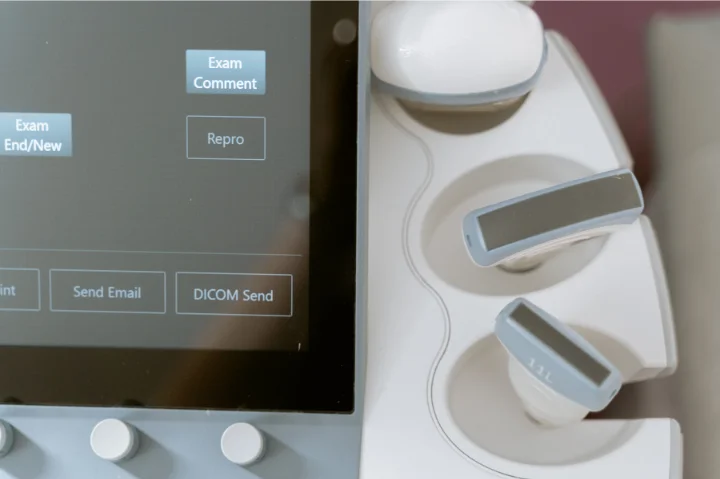
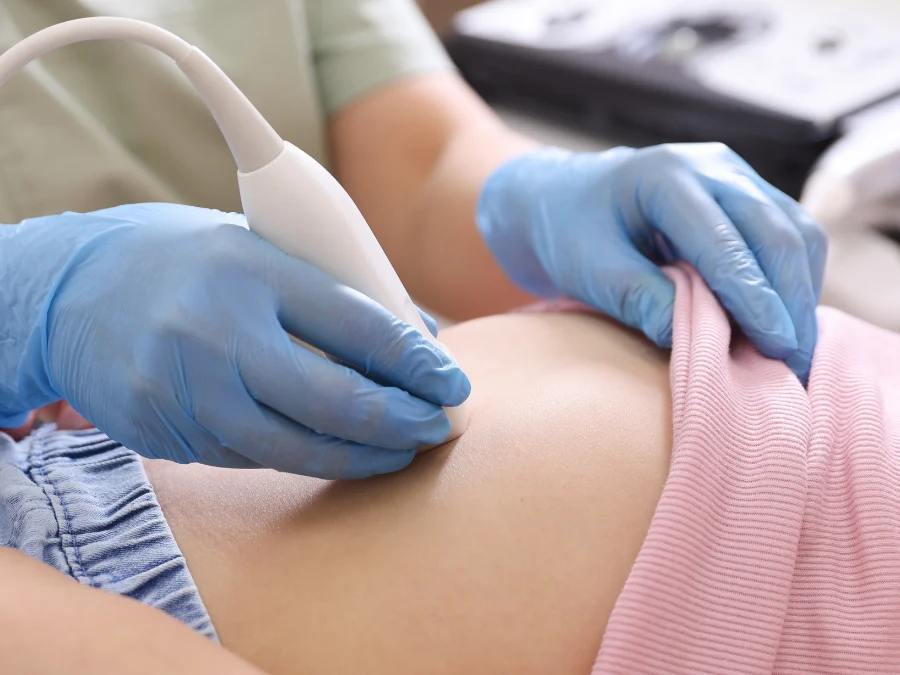
A small handheld device, called a probe, sends sound waves into your body and picks up the echoes. A computer turns these echoes into moving pictures on a screen.
Most ultrasound scans are external: the probe moves over a layer of gel on your skin. Some pelvic examinations use a thin internal (vaginal) probe to get closer views. External and internal scans are different examinations with different preparation and consent.
Why might I need an ultrasound scan?
To look into symptoms, check a lump or follow up a known finding.
Your doctor may suggest an ultrasound scan to investigate symptoms, examine a lump or monitor something found before. The area scanned depends on the question your doctor wants to answer.
| Scan area | What it may help assess |
|---|---|
| Upper abdomen | The liver, gallbladder and other abdominal organs — for example, fatty liver or suspected gallstones. |
| Kidneys and bladder | Kidney size and appearance, swelling from blocked urine flow, and how well the bladder empties. |
| Pelvis | The womb (uterus) and ovaries — for example, possible fibroids or ovarian cysts. |
| Thyroid and neck | Thyroid enlargement, nodules or some neck lumps. |
| Pregnancy | How an early pregnancy is developing. The type of scan depends on the stage and the medical need. |
Ultrasound can help with diagnosis, follow-up and some screening questions, but it is not a complete check for every disease. If your health screening report mentions fatty liver, read what a fatty liver result actually means.
What does an ultrasound scan at our Kepong clinic include?
A focused scan by the doctor, explained to you in the same visit.
At Klinik Medilove Keponggi, the doctor performs the scan and talks you through what they see during the same consultation. We currently scan:
- Abdomen — liver, gallbladder and kidneys
- Pelvis — womb, ovaries and bladder
- Early pregnancy
- Add-on: POCUS echo — a quick bedside heart ultrasound (POCUS means point-of-care ultrasound)
Is a GP ultrasound the same as a specialist scan? Not always. A GP scan is usually focused — it answers a particular question during your consultation. A comprehensive examination may need a radiologist, sonographer or other specialist. If you need a full radiologist scan or a formal echocardiogram, we will refer you.
Before your scan, ask what the appointment includes: the area examined, who performs it, whether you get a written report, and whether further imaging may be needed. See all our services on the clinic services page.
Who should tell the doctor before the appointment?
A quick message beforehand lets us plan your scan safely.
Contact us before your appointment if you:
- Take insulin or other diabetes medicines and have been asked to fast.
- Have a fluid restriction (for example, for heart or kidney disease), or find it hard or painful to hold urine.
- Are pregnant or could be pregnant.
- Need help changing position, communicating or feeling comfortable during the examination.
- Have reacted to ultrasound gel before, or have a latex allergy and an internal scan is being considered.
If an intimate (internal) examination is suggested, the doctor should explain why it is needed and what the alternatives are. You can ask for a chaperone, and a female doctor is available — please ask when you book. You can decline or ask to stop at any time.
How should I prepare for an ultrasound scan?
Preparation depends on which part of your body is being scanned.
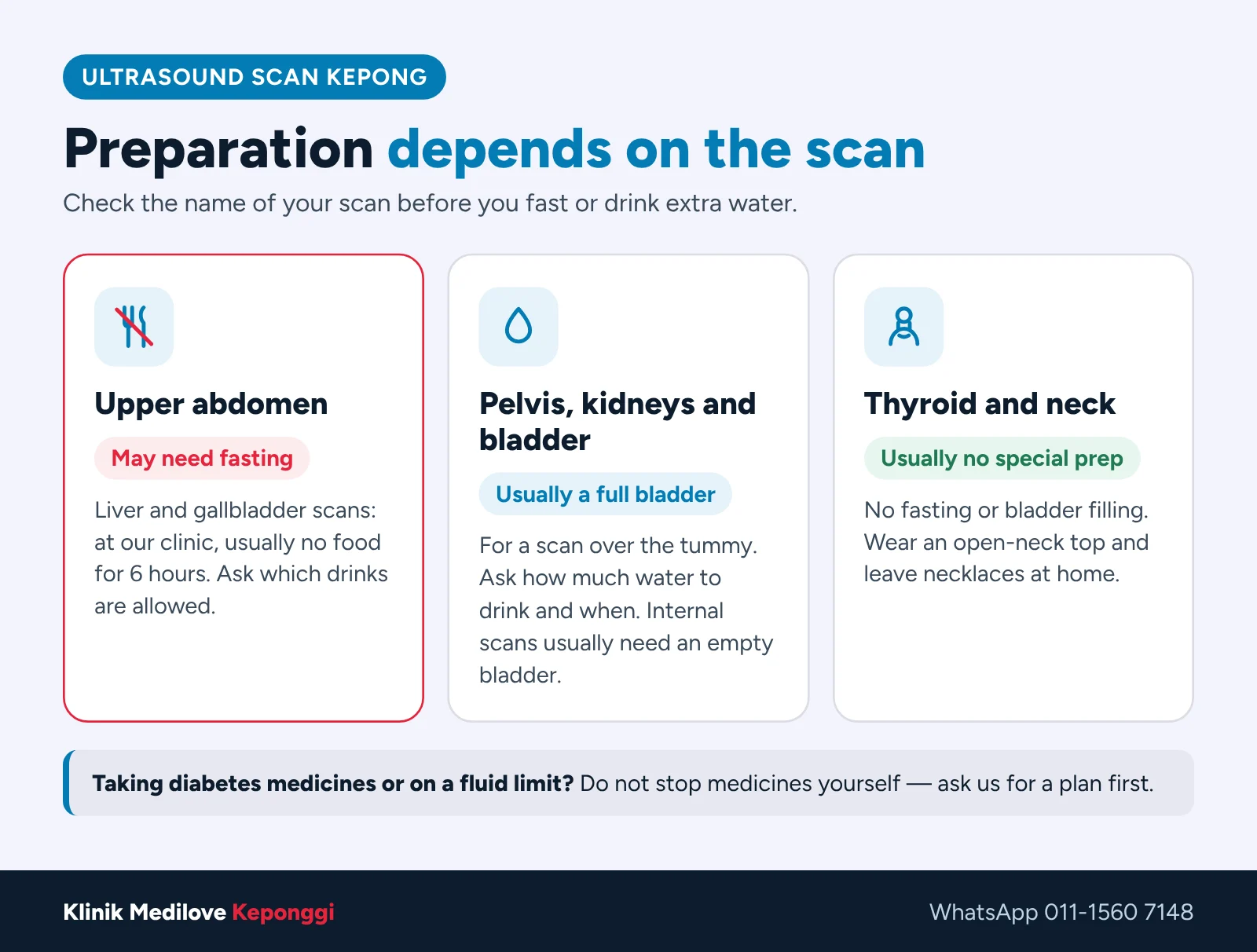
Check the name of your scan first. Do not fast or drink large amounts of water just because your appointment says “ultrasound”.
| Examination | Usual preparation | What to confirm |
|---|---|---|
| Upper-abdominal scan (liver, gallbladder) | At our clinic: usually no food for 6 hours before. | Which drinks are allowed, and how to take your medicines. |
| Pelvic scan over the tummy | Usually a full bladder. | How much water to drink and when to start. |
| Kidney-and-bladder scan | Usually a full bladder. You may also be scanned after passing urine. | Whether you also need to fast for other abdominal views. |
| Thyroid or neck scan | Usually no fasting or bladder filling. | Wear a top that leaves your neck easy to reach. Remove necklaces. |
| Internal (vaginal) scan | Usually an empty bladder. | Whether this examination is needed and available for you. |
| Early pregnancy scan | Depends on the stage of pregnancy and the scan approach. | Follow the instructions for your appointment. |
Malaysian hospital radiology departments separate fasting for upper-abdominal scans from bladder filling for urinary and pelvic scans. Exact instructions are local protocols, not one national rule for every scan.
Do
- Check which scan you are having and its instructions.
- Bring previous scan reports, recent blood results, your medicine list and any referral letter.
- Wear loose, comfortable clothing that gives easy access to the area.
- Tell staff if your bladder becomes painfully full.
Don’t
- Stop insulin or other prescribed medicines because of general internet advice — ask us for a plan.
- Drink large amounts of water if you have a fluid restriction — ask for an adapted plan.
- Fast longer than you were asked to.
What happens during an ultrasound scan?
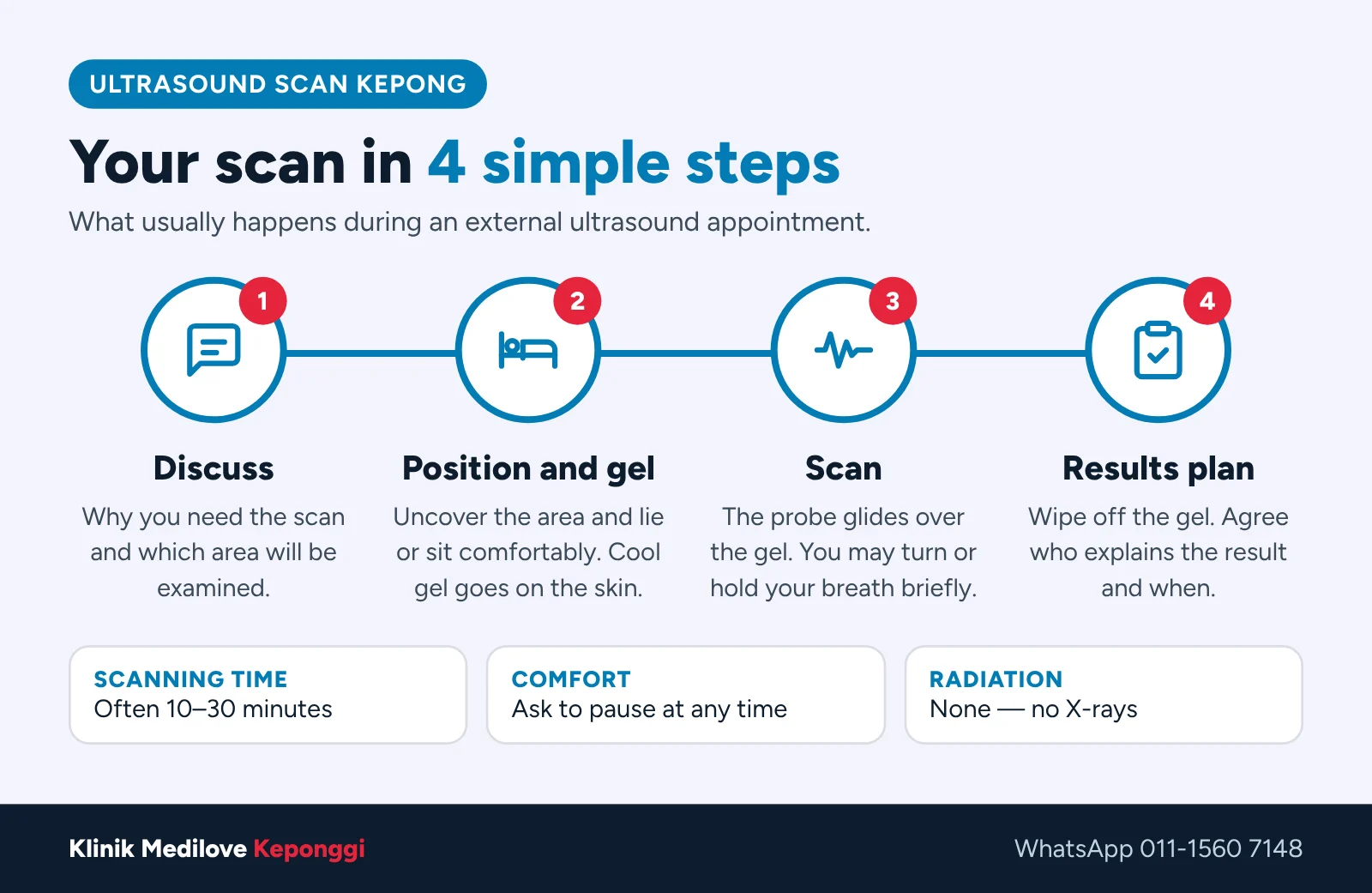
Four simple steps for a routine external scan.
Discuss the reason for your scan
The doctor checks your symptoms, relevant history and the examination you have agreed to.
Get comfortable
You uncover the area to be scanned and lie or sit in position. Cool gel is put on your skin to help the probe make good contact.
Images are taken
The probe moves over the area. You may be asked to turn or hold your breath for a few seconds. Short pauses while measurements are taken are normal.
Plan the next step
Wipe off the gel and get dressed. Agree how you will receive the findings and any follow-up.
Does an ultrasound scan hurt, and are there risks?
Usually comfortable, with no radiation and no needles.
An external scan is usually comfortable. Pressure on an area that is already sore can hurt, and a full bladder can feel uncomfortable. Tell the doctor — they can adjust the pressure or pause.
Standard diagnostic ultrasound has no known harmful effects when used appropriately. It does not use ionising radiation such as X-rays, and a routine external scan does not need an injection or anaesthetic. If a biopsy or other procedure is suggested, its risks and preparation will be discussed separately.
What happens after the scan?
Most people go straight back to normal activities.
After a routine external scan you can usually go back to your normal activities, including work and driving. You can eat and drink again unless another planned test needs you to keep fasting. Follow any individual advice from your consultation.
When will I get my results, and what might they mean?
The doctor usually explains the findings during the same visit.
Some findings can be explained straight away. A written report or specialist review may take longer. Before you leave, check who will explain the result, when to expect it, and whom to contact if it does not arrive.
| Finding | What may happen next |
|---|---|
| No clear abnormality in the area examined | Your doctor considers whether your symptoms need further tests. |
| A finding that needs monitoring | Comparison with previous scans, or a planned repeat scan. |
| An uncertain or unexpected finding | Further imaging, blood tests or a specialist opinion, depending on what is seen. |
| A possibly urgent problem | Prompt assessment or referral, depending on the situation. |
A finding is not automatically cancer. Equally, a normal scan cannot rule out every cause of symptoms. Ultrasound pictures can be limited by bowel gas, how deep an organ lies and the area examined, so further tests may sometimes be needed.
When should I seek urgent help?
Some symptoms cannot wait for a routine scan.
Do not wait for a scan appointment. Go to the nearest emergency department or call 999 if you have:
- Sudden, severe abdominal pain
- Collapse or fainting
- Vomiting blood, or black, sticky stools
- Being unable to pass urine
If you could be pregnant, pelvic pain or vaginal bleeding needs prompt medical assessment. Severe pain, pain at the tip of the shoulder, dizziness or fainting may mean an emergency such as an ectopic pregnancy.
Ultrasound scan FAQ
Answers to the questions patients in Kepong ask us most.
Can I book an ultrasound scan without knowing which scan I need?
Yes, but ask us first. Tell us your symptoms and how long you have had them, or send a previous report. A consultation may be the best first step, and the doctor will decide which area to scan.
What if I have eaten or emptied my bladder before the scan?
Tell us before the scan starts. Depending on the examination, we may still go ahead, ask you to wait (for example, to drink more water) or rearrange the appointment. Do not hide it, and do not extend your fast on your own.
Will a pelvic scan always be internal?
No. A pelvic scan can be done over the tummy, internally, or both. The doctor should explain why a particular approach is recommended and ask for your consent first. You can say no or ask to stop.
Can an ultrasound scan detect every cancer?
No. Ultrasound can show some abnormalities, but it cannot reliably find or rule out all cancers. A suspicious finding may need other imaging or a tissue sample (biopsy).
Does a thyroid scan tell me whether my thyroid hormones are normal?
No. A thyroid ultrasound looks at the structure of the gland, such as size and nodules. A blood test checks how well your thyroid is working. Your doctor will advise whether you need one or both.
Does an early pregnancy scan replace my other antenatal scans?
No. Ask what the scan is for and what it covers. A focused early pregnancy scan does not include the detailed checks needed later in pregnancy, so keep your regular antenatal appointments.
Is ultrasound safe in pregnancy?
Diagnostic ultrasound has no known harmful effects when used appropriately, and it does not use radiation. Scans in pregnancy should still be done for a medical reason, using the lowest exposure needed.
How much does an ultrasound scan cost, and can I walk in?
Fees depend on the area scanned. WhatsApp us for the current fee and the next available slot. Check whether the fee includes the consultation, the scan, images, a written report and any follow-up.
Clinical sources
- Hospital Pakar Sultanah Fatimah, Ministry of Health Malaysia. Radiology handbook 2026 — upper-abdominal versus pelvic and urinary scan preparation.
- Hospital Selayang, Ministry of Health Malaysia. Diagnostic imaging: information for patients.
- NHS. Ultrasound scan — what to expect, consent, comfort and results.
- ACR/RSNA RadiologyInfo. General ultrasound, abdominal ultrasound, pelvic ultrasound and thyroid ultrasound — uses, safety and limitations.
- Guy’s and St Thomas’ NHS Foundation Trust. Head and neck ultrasound scan.
- AIUM. Practice parameter for point-of-care ultrasound — scope and limits of focused scans.
- NHS. Stomach ache and ectopic pregnancy symptoms — urgent warning signs.
Ask about an ultrasound scan in Kepong
Not sure which scan you need? Tell us your symptoms or send your previous report on WhatsApp, and we will advise on the next step, preparation and fees. Having a health check too? Read how to prepare for your health screening or see our health screening packages. If your doctor has asked for thyroid blood tests as well, read our blood test preparation guide.
Ask us on WhatsApp
Patient-friendly primary care, screening and women’s health services.
Find us
Lot C-08-G (ground floor), KepongGi,
Jalan Rimbunan Teratai 1,
52100 Kepong, Kuala Lumpur
Contact
011-1560 7148 (phone / WhatsApp)
Mon–Fri 8:00 am–9:00 pm
Sat–Sun 8:00 am–6:00 pm