Reading time: 6 minutes · Written by Dr Ang at Klinik Medilove Keponggi, Kepong
Every week in clinic, someone puts a screening report on my desk and points to one line: “fatty liver, mild to moderate.” Then they ask the same question. Doctor, is this serious? I feel perfectly fine.
Feeling fine is exactly the problem. Fatty liver is quiet for years — and then, in a small but real number of people, it isn’t.
Here is what that line means, how to read the rest of your report alongside it, and what actually works to reverse it.
Fatty Liver is far more common than you think
A nationwide Malaysian study published in 2025 found that 28.2% of Malaysian adults have metabolic fatty liver disease — more than one in four of us, roughly 6.7 million people. Abdominal obesity was present in over half the population sampled.
So if your report says fatty liver, you are not unlucky. You are in the majority of middle-aged Malaysians walking around Kepong today.
That does not make it harmless. It makes it worth understanding.
The name changed — and the new name is the point
You may have heard it called NAFLD (non-alcoholic fatty liver disease). Since 2023, doctors worldwide use a new name: MASLD — metabolic dysfunction-associated steatotic liver disease.
The change matters. The old name defined the condition by what it wasn’t (alcohol). The new name says what it is: a liver problem driven by metabolic dysfunction — the same insulin resistance, waistline and blood-fat problem that drives diabetes and heart disease.
Your liver is not a separate issue from your sugar and your cholesterol. It is the same issue, showing up in a different organ.
The four stages — and where the door closes
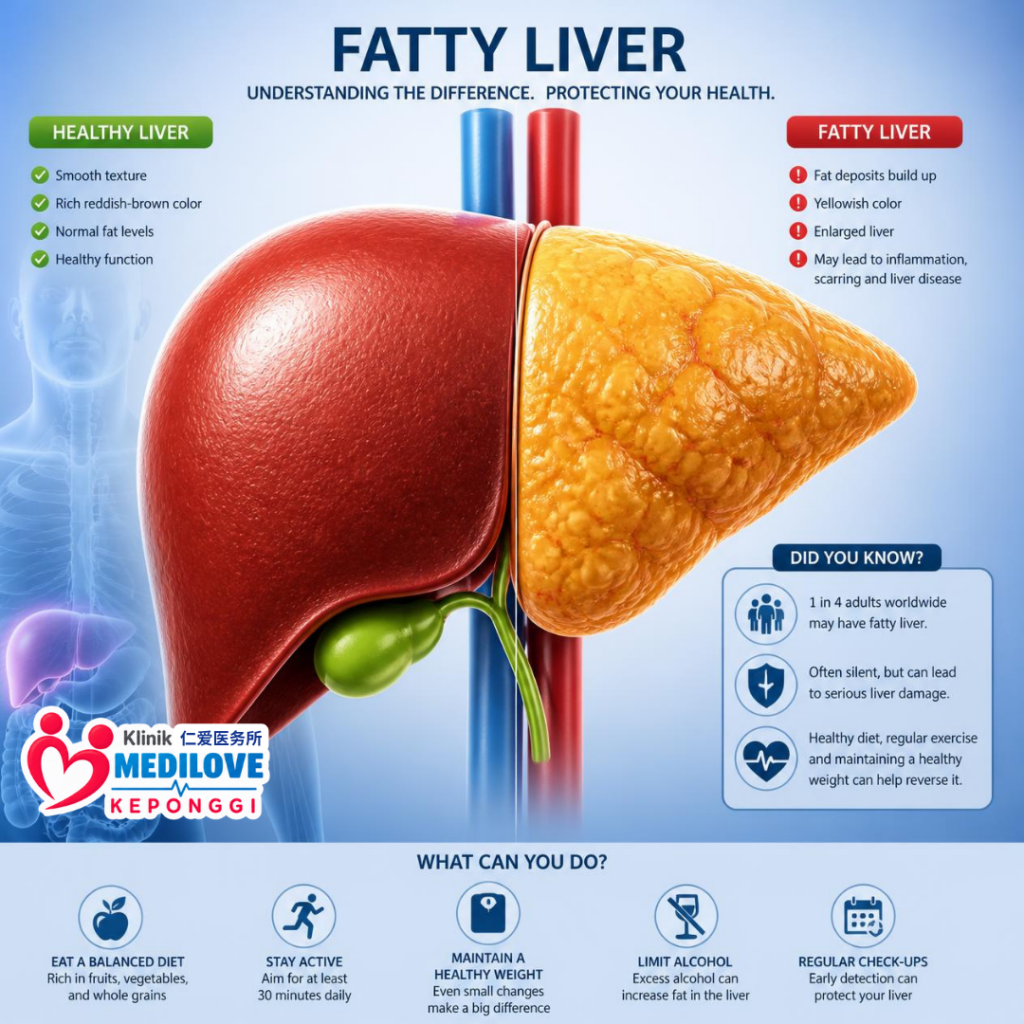
Stage 1 — Healthy liver. Less than 5% fat. Liver function tests normal.
Stage 2 — Fatty liver (MASLD). More than 5% of the liver is fat. Visible on ultrasound. No damage yet. Fully reversible.
Stage 3 — Inflammation (MASH). Fat is now irritating the liver cells. ALT often rises. Still reversible — but this is where scarring begins to be laid down.
Stage 4 — Fibrosis and cirrhosis. Scar tissue replaces working liver. This is the stage we cannot undo.
Most people reading this are at stage 2. A meaningful minority are at stage 3. The whole purpose of picking it up on a screening is to act while the door is still open.
This is the same silent pattern we see in kidney disease — no symptoms until the damage is structural.
How to read your own report
Fatty liver on ultrasound is only half the diagnosis. MASLD = fat in the liver PLUS at least one of these five cardiometabolic criteria. Look them up on your own report:
What to look for
The threshold
Waist circumference
≥90 cm (men) · ≥80 cm (women), or BMI ≥23
Blood sugar
Fasting ≥5.6 mmol/L, HbA1c ≥5.7%, or known diabetes
Blood pressure
≥130/85 mmHg, or already on BP medication
Triglycerides
≥1.7 mmol/L, or already on lipid medication
HDL (“good”) cholesterol
<1.0 mmol/L (men) · <1.3 mmol/L (women)
Note the Asian waist cut-offs. They are lower than the Western ones for good reason — South and East Asians accumulate visceral fat and develop insulin resistance at a lower BMI. A 78 kg man in Kepong can carry a metabolic risk that a 78 kg man in Copenhagen does not.
The test that actually decides how worried to be
Ultrasound tells us there is fat. It does not tell us whether there is scarring — and scarring is what determines your future.
The first step is a simple calculation called FIB-4, which uses your age, ALT, AST and platelet count. You almost certainly already have all four values on your existing blood test. No extra blood needed.
FIB-4 low → advanced scarring is very unlikely. Focus on lifestyle, recheck in 1–2 years.
FIB-4 indeterminate or high → you need a second test, usually FibroScan (transient elastography), which measures liver stiffness, or referral to a liver clinic.
If you bring us a screening report showing fatty liver, this is the number we will work out for you. It costs nothing extra and it changes the plan.
Five things that reverse it
There is no pill for early fatty liver. These five are the treatment.
1. Lose 5–10% of your body weight. This is the single most powerful intervention we have. Losing 5% measurably reduces liver fat. Losing 7–10% can clear the inflammation of MASH, and sustained loss above 10% can even improve early fibrosis. For an 80 kg person, 5% is 4 kg — not a transformation, a target.
2. Cut the sugary drinks first. If you change one thing this week, make it this. Fructose from teh tarik, bubble tea, bottled juice and sweet kuih is metabolised directly into liver fat. Two sweet drinks a day is a meaningful daily fat delivery to your liver. Kurang manis is a start; kosong is the goal.
3. Move 150 minutes a week. Brisk walking, 30 minutes, five days a week, plus two sessions of resistance work. Exercise reduces liver fat even if the scale does not move — the benefit is not conditional on weight loss.
4. Limit alcohol. And stop completely if fibrosis has already started. Alcohol and metabolic fat injure the liver through overlapping pathways; together they are worse than either alone.
5. Treat the rest of the picture. Get the diabetes, blood pressure and cholesterol controlled. Certain diabetes medications, particularly the GLP-1 class, improve liver fat as well as sugar. For people with confirmed moderate-to-severe fibrosis, specific liver drugs now exist — but that is a specialist decision, after staging.
Then recheck liver enzymes and recalculate FIB-4 in 6 months. A plan without a recheck date is a wish.
The part most people get wrong
Ask most patients what fatty liver will kill them with, and they say liver failure.
It won’t, for the overwhelming majority. The number one cause of death in people with fatty liver is cardiovascular disease — heart attack and stroke. Fatty liver is best understood as a warning light on the dashboard of your whole metabolism, not an isolated liver problem.
Which is oddly good news. The things that protect your liver are the same things that protect your heart. You are not fighting on two fronts.
What we do at Medilove Keponggi
If you have a screening report with fatty liver on it — from us or from anywhere else — bring it in. In one visit we will:
work out your FIB-4 score from your existing results
measure your waist properly (most reports don’t)
check whether the other four cardiometabolic criteria are met
set one realistic weight target and one drink to cut
book the 6-month recheck before you leave
If you have never been screened, our full body screening package includes liver function, lipids, HbA1c and the measurements needed to answer this question properly.
Frequently asked questions
Does fatty liver cause pain? Usually not. Some people describe a vague fullness or discomfort under the right ribs, but most feel nothing at all. Pain is not a reliable guide, in either direction.
I don’t drink alcohol. How can I have fatty liver? This is the most common question we get, and it is why the name was changed. MASLD is driven by insulin resistance and metabolic risk, not alcohol. Plenty of lifelong teetotallers have it.
I’m not overweight. Can I still have it? Yes. Around 1 in 5 people with fatty liver have a normal BMI — “lean MASLD”. Waist circumference and visceral fat matter more than the number on the scale, especially in Asians.
Will the fat go away completely? In early-stage fatty liver, yes — the liver is genuinely capable of clearing it with sustained weight loss and reduced sugar intake. Established scarring is a different matter, which is why staging early is so important.
Do I need a liver biopsy? Almost certainly not. Non-invasive tests — FIB-4 followed by FibroScan where needed — answer the question for the large majority of people.
How often should I recheck? Low FIB-4 with lifestyle change: every 1–2 years. Indeterminate or high, or if you have diabetes: at least yearly, guided by your doctor.
Klinik Medilove Keponggi Lot C, Keponggi, 08-G, Jalan Rimbunan Teratai 1, Kepong, 52100 Kuala Lumpur Open Mon–Fri 8:00am–9:00pm · Sat–Sun 8:00am–3:00pm WhatsApp: https://wa.link/i8asmp · Call: +6011-1560 7148