“But I feel fine”
The difficult truth about the most common chronic diseases in Malaysia is that feeling fine is not evidence of being fine. They are silent for years, and by the time they announce themselves, some of the damage is already done.
The National Health and Morbidity Survey 2023 measured this directly. Among Malaysian adults:
- 15.6% have diabetes — and two in five of them did not know it.
- 29.2% have high blood pressure — 17.3% knew, 11.9% did not. That is roughly two in five again, unaware.
- 33.3% have high cholesterol — and about half had no idea.
The figure that should stop anyone under 30 from clicking away: among adults aged 18–29 who were found to have diabetes, 84% were undiagnosed.
None of those people felt ill enough to get tested. That is the entire point of screening — it is designed for people who feel well. If you already feel unwell, what you need is a consultation, not a screening package.
What a health screening can honestly find — and what it can’t
A screening is a set of tests chosen because they catch common, serious, treatable things early. It is not a scan of your entire body, and any claim that it is should be treated with suspicion.
A standard screening can reasonably pick up:
- Raised blood glucose or HbA1c — diabetes and pre-diabetes
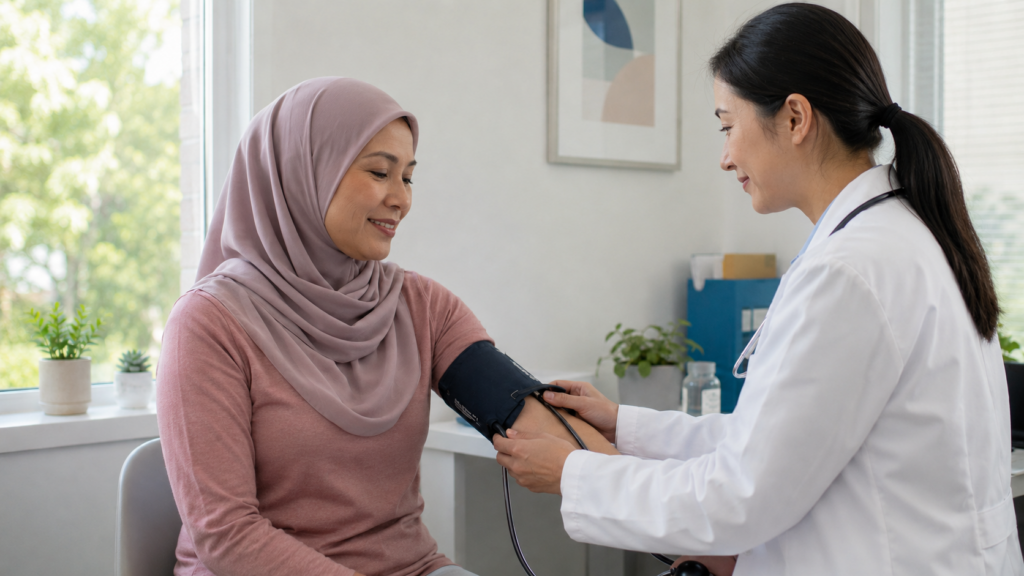
- High blood pressure
- Abnormal cholesterol
- Early kidney problems, through protein in the urine and kidney function on a blood test
- Anaemia, and some liver and thyroid abnormalities
- Specific cancers, but only through the specific tests designed for them — cervical, breast and colorectal screening are separate programmes, not a line on a general blood panel
A screening cannot:
- Rule out cancer generally. There is no blood test that clears you of all cancers.
- Guarantee anything about next year. A normal result describes today.
- Replace a consultation about a symptom you already have.
- Avoid the occasional false alarm. Some results come back mildly abnormal in people who turn out to be perfectly healthy, and chasing them costs money, time and sleep. This is a real cost of screening, and it is worth knowing about before you start rather than after.
Screening is a reasonable bet, not a guarantee. It is worth doing because the conditions it finds are common, silent, and much easier to manage early — not because it makes you invulnerable.
Who should be screened, and from what age
Malaysian guidelines are reasonably specific, which helps. You do not need to guess.
From age 30 — diabetes
The Malaysian clinical practice guideline recommends screening asymptomatic adults for diabetes from age 30, annually, using fasting glucose or HbA1c.
Start earlier if you are overweight or obese — BMI ≥23 kg/m² in our population, or a waist of 80 cm or more in women and 90 cm or more in men
— and you have at least one of:
a family history of type 2 diabetes, high blood pressure, abnormal lipids, physical inactivity, heart disease, or polycystic ovary syndrome.
Screening also applies regardless of your weight if you have had gestational diabetes, or if you already have pre-diabetes, in which case testing is yearly.
The waist measurement matters here. Central weight around the middle at a normal BMI is common in our population, and it is easy to be told your BMI is fine while your waist says otherwise.
Blood pressure and cholesterol are usually checked at the same visit, because they cluster together and are treated together.
Women aged 30–65 — cervical screening
Malaysia’s cancer control plan recommends HPV testing every five years for sexually active women aged 30–65 who test negative. The sample can be self-collected — you do not necessarily need a speculum examination, which removes the single most common reason women postpone this for a decade.
From age 40 — breast
Clinical breast examination by a trained professional is recommended every three years from age 20–39, and annually from 40. Mammogram is recommended annually from 40 for women with risk factors, and two-yearly for women aged 50–74.
From age 50 — colorectal
Asymptomatic adults aged 50–75 are recommended to screen with iFOBT, a stool test, every two years. It is done at home. For most people in this age group it is one of the highest-yield tests on the list, and the one most often skipped.
If you already have diabetes or high blood pressure
Then this is not screening — it is monitoring, and it is not optional. That includes checks on your kidneys, because kidney damage from diabetes is silent until it is advanced. If you want to understand what those kidney numbers mean, read CKD Stages Explained: What Stage 1–5 Mean for You. Urine albumin testing is part of the standard baseline assessment in diabetes, alongside an annual dilated eye examination.
The three worries we actually hear
“What if they find something?”
This is the most common reason people delay, and it is completely understandable. But the thing being found does not appear because you looked for it — it is already there. What changes is the stage at which you meet it.
Early type 2 diabetes can often be managed with weight, diet and one tablet. Late diabetes brings kidney failure, vision loss and amputations. Early colorectal cancer is frequently curable. The diagnosis is not the bad outcome. Finding it late is.
“Can I afford it?”
Screening may cost you nothing. PeKa B40 provides free health screening for Malaysians aged 40 and above in the B40 group; recipients of Sumbangan Tunai Rahmah and their registered spouses qualify automatically, with no separate enrolment. It covers physical examination, mental health screening, and blood and urine tests at MOH facilities and participating private clinics. You can check eligibility online with your MyKad before going anywhere.
Government health clinics also provide screening at minimal cost. If money is the barrier, the barrier is smaller than most people assume — and it is worth asking rather than assuming.
“I don’t have time”
For most people a screening is one short visit with fasting blood taken, and a second short visit to go through the results properly. The stool test for colorectal screening is done at home. The cervical sample can be self-collected. The time cost is genuinely modest, and it is much smaller than the time cost of managing a complication.
What actually happens at a screening
- A conversation first. Your history, your family history, your medications, what you are actually worried about. This determines which tests are appropriate — screening should be chosen to fit you.
- Basic measurements. Blood pressure, weight, height, waist circumference.
- Blood and urine tests. Usually fasting; you will be told beforehand.
- Additional programme tests where relevant to your age and sex — cervical, breast or colorectal screening.
- A results consultation. This is the part that matters — numbers only become useful once someone explains what they mean for you.
If a result comes back abnormal
One abnormal number is information, not a diagnosis. Most are repeated or confirmed with a second test, and interpreted alongside everything else about you. A borderline reading in a 35-year-old with no risk factors means something different from the same reading in a 55-year-old with a family history.
What should follow is a plan you actually understand: what the number means, whether it needs repeating, what would change it, and when you are coming back.
When screening is the wrong answer
If you already have a symptom, do not book a screening package — see a doctor about the symptom. Screening tests are designed for people without symptoms and can be falsely reassuring in people who have them.
See a doctor promptly if you have: a new breast lump, blood in your stool or urine, unintentional weight loss, a persistent change in bowel habit, a cough lasting more than two weeks — that is the threshold for tuberculosis testing in Malaysia — a cough with fever or night sweats, coughing up blood, unusual vaginal bleeding, or persistent unexplained tiredness.
Seek emergency care immediately for: chest pain or pressure; sudden weakness or numbness in the face, arm or leg, especially on one side; a drooping face; difficulty speaking or sudden confusion; sudden loss or blurring of vision; a sudden severe headache; difficulty breathing; fainting; or sudden severe abdominal pain. Go to the nearest emergency department or call 999. Do not wait for an appointment.
Common questions
Do I need to fast before a health screening? Usually yes, for glucose and cholesterol — typically 8 to 10 hours, water allowed. You will be told when you book. If you have diabetes and take medication, ask how to handle your morning dose before you fast.
How often should I repeat it? For most adults with normal results and no risk factors, annually for diabetes and blood pressure is a reasonable rhythm. Cancer screening follows its own intervals — five years for HPV, two years for iFOBT and for mammogram from 50.
Is a more expensive package a better screening? Not automatically. More tests mean more findings that need chasing, and not all of them matter. A screening matched to your age, sex and risk is better medicine than a longer list.
I’m in my twenties. Is there any point? Usually not a full package — but if you have a strong family history of diabetes, heart disease or high cholesterol, or you are overweight, a basic check is reasonable. Remember that 84% of 18–29 year olds found to have diabetes in NHMS 2023 did not know.
Can I do the cervical and colorectal tests myself? The HPV sample can be self-collected, and the iFOBT stool test is done at home. Both are then processed by the lab. This removes the embarrassment barrier that stops a lot of people.