











Weight loss injection not working? 9 common reasons and what to do
Is your weight loss injection not working? You started Mounjaro hoping for the results everyone posts online. A few weeks — or a few months — later, the scale has barely moved. Maybe a friend lost 8 kg in the same time. Maybe you are wondering whether it is worth the money, or whether you should simply take more.
If you are not losing weight on Mounjaro, you are not alone, and it rarely means the medicine “doesn’t work on you”. There is usually a specific reason — and the most common one is simply that it is still early. This guide explains what results are realistic, the 9 most common reasons weight loss is slow, and what international guidelines say about when to review treatment.
Mounjaro is the brand name for tirzepatide, a once-weekly injection that acts on 2 gut hormone pathways (GIP and GLP-1) to reduce hunger, help you feel full sooner and lower blood sugar. It is a prescription-only medicine in Malaysia.
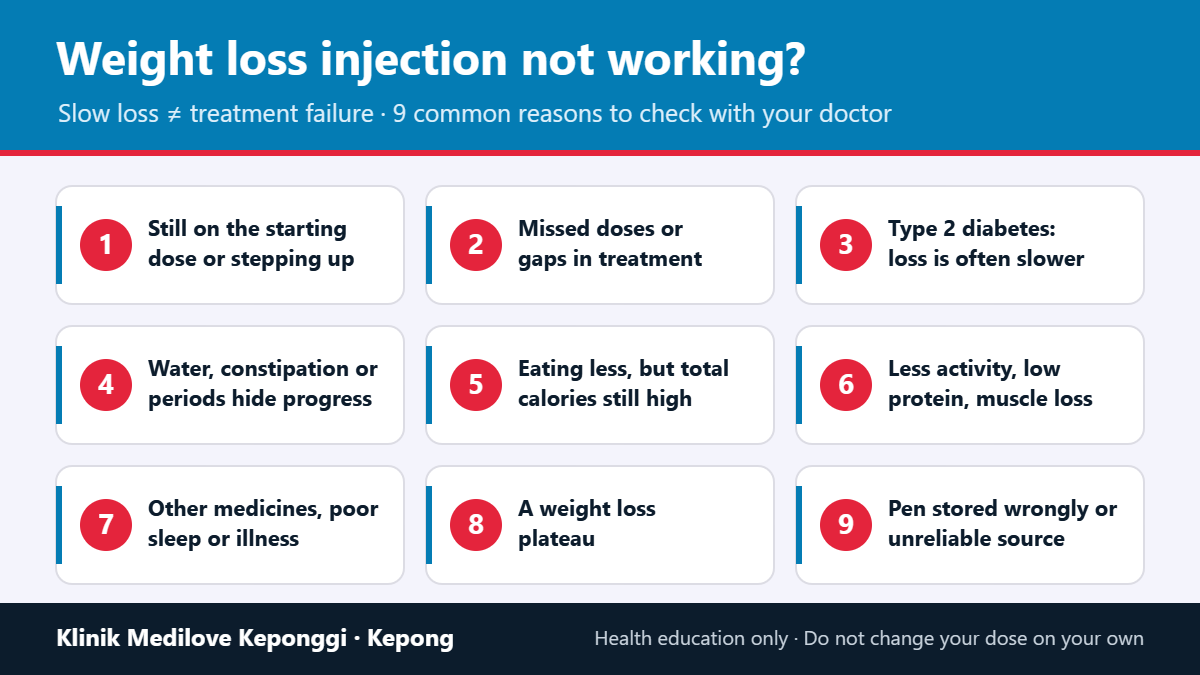
- Slow at first is normalTreatment starts low and steps up every 4 weeks or more. Slow loss while the dose is still going up is not the same as not responding.
- 5% is the review markNICE suggests reviewing treatment if you have lost less than 5% after 6 months on your highest tolerated dose — not after 1 month.
- Never self-adjustDon’t raise the dose, double up, or buy cheaper pens online. Bring your record to a review instead.
How much weight loss can you expect from a weight loss injection?
Large clinical trials give a useful guide, but they cannot predict how much any one person will lose. Social media shows the best results, not the typical ones.
Adults with obesity, without diabetes (SURMOUNT-1)
Average weight lost after 72 weeks, by weekly dose
85% to 91% of people on tirzepatide lost at least 5% — so roughly 1 in 10 lost less. Source: Jastreboff et al., New England Journal of Medicine, 2022.
Adults with obesity and type 2 diabetes (SURMOUNT-2)
Average weight lost after 72 weeks, by weekly dose
HbA1c also fell by about 2 percentage points. The 2 trials enrolled different people, so this is not a direct comparison. Source: Garvey et al., The Lancet, 2023.
Everyday practice (7,881 adults, semaglutide or tirzepatide, USA)
Average weight lost after 1 year, by whether treatment continued
The overall average was 8.7%, lower than in trials mainly because many people stopped early or stayed on lower doses. Source: Gasoyan et al., Obesity, 2025 (Cleveland Clinic).
The key message: these are results after 72 weeks — about a year and a half — including the months spent stepping up the dose. They are not what to expect after 4 or 8 weeks.
Slow loss while the dose is still going up is not the same as not responding
This is the most useful distinction in this whole article. According to the prescribing information, tirzepatide starts at 2.5 mg once a week for 4 weeks. That dose is for starting treatment — letting your stomach and gut adjust — and is not intended as a treatment dose. After that, the dose can be increased in 2.5 mg steps, each after at least 4 weeks on the current dose, depending on how you respond and tolerate it.
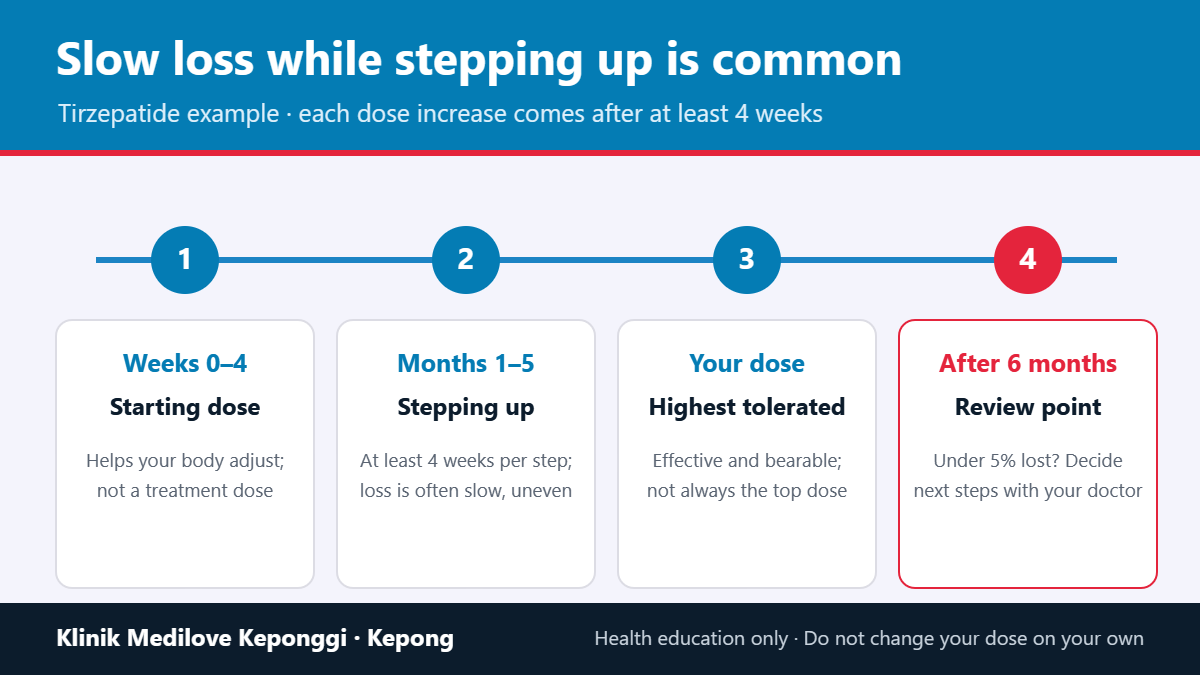
- Weeks 0–4Starting dose. Mostly about getting used to the medicine.
- Months 1–5Stepping up, no faster than every 4 weeks. Weight loss often slow and uneven.
- Your highest tolerated doseThe dose that works and that you can live with — not always the maximum.
- 6 months on that doseNICE’s review point: if less than 5% lost, decide together whether to continue.
So someone who has used Mounjaro for 3 weeks — or who is 3 months in and still stepping up — has not “failed” treatment. They have not reached the point where response can fairly be judged.
Check your progress against the 5% review mark
Use this educational checker to see where you stand. It is not a treatment decision tool, and nothing you enter is saved or sent anywhere.
Your progress
You are still stepping up the dose. Slow or uneven weight loss now is common and is not the same as not responding.
Based on NICE TA1026 (tirzepatide), where the 5% review applies after 6 months on the highest tolerated dose — not 6 months from your first injection. Your doctor will also consider your waist, blood pressure, blood tests and side effects.
Weight loss injection not working? 9 common reasons
Tap each reason to open it. If one sounds like you, tick “This might be me” — your ticks build a checklist you can bring to your doctor.
1You’re still on the starting dose or stepping up
The first month’s dose is for starting treatment, not for weight loss. Many people lose a little at first (some of it water), then less while the dose is still going up. In the SURMOUNT-1 trial, it took 20 weeks just to reach the highest dose.
What guidelines say: follow the prescribed step-up schedule. Don’t increase sooner than every 4 weeks, and don’t assume the maximum dose is right for everyone — some people reach their goals on a lower dose.
2Doses are being missed, or treatment keeps stopping and starting
A weekly injection is easy to miss — a busy week, a balik kampung trip, a delay picking up the next pen. Some people pause for a few weeks when money is tight, then restart. Each gap lets appetite come back, and a long break may mean going back to a lower dose.
In a study of nearly 8,000 adults, people who stopped within 3 months lost 3.6% on average, compared with 11.9% for those who kept going. More than 80% were on lower maintenance doses, and those on higher doses lost more.
What you can do: set a weekly phone reminder. If you miss a dose, the prescribing information says to take it within 4 days; after that, skip it and take the next one on your usual day — never 2 doses within 3 days. If cost is the real problem, tell your doctor: a planned approach works better than an on–off one. Always use the instructions for your exact pen, as devices differ between products and countries.
3You have type 2 diabetes
People with type 2 diabetes usually lose weight more slowly. In the trials, the average was about 13% to 15% with diabetes, compared with up to 21% without — though the 2 trials enrolled different people. NICE’s obesity guideline specifically tells doctors to take this into account when agreeing goals.
This is not failure. Tirzepatide is also lowering your blood sugar, and HbA1c (a 3-month average of blood sugar) fell by about 2 percentage points in SURMOUNT-2.
What you can do: judge progress by your weight trend and your HbA1c, blood pressure and waist — not the scale alone.
4Water, constipation or your cycle are hiding fat loss
Body weight includes fat, muscle, water and whatever is in your gut. Your weight can go up or down by a kilogram or more from one day to the next because of salty food, fluid, the menstrual cycle or constipation — and constipation is a recognised side effect of tirzepatide.
What you can do: weigh yourself once a week, same day, same time, after the toilet and before breakfast. Follow the trend over several weeks, not single readings. Measure your waist once a month.
5Calories are slipping past a smaller appetite
Mounjaro turns down hunger. It does not choose your food. The calories most likely to slip through are the ones that don’t fill you up:
- Drinks — kopi or teh tarik with condensed milk, bubble tea, fruit juice, soft drinks, alcohol
- Grazing — biscuits, kuih and snacks eaten without real hunger
- Late-night supper — after a long shift, from habit rather than hunger
- Small but rich portions — less food overall, but mostly fried food, pastries or rice with oily lauk
What guidelines say: NICE says all weight-management medicines should be used alongside a reduced-calorie diet and more physical activity. You don’t need a crash diet — but for 2 weeks, write down everything you drink. For many people, that one list explains the stall.
6You’re moving less, eating too little protein, or losing muscle
Some people become less active when they eat less, especially with tiredness or nausea. And when appetite is small, people often skip fish, eggs and tofu and fill up on rice, bread or snacks.
Weight loss is never pure fat. In a body-scan study within SURMOUNT-1, about three-quarters of the weight lost was fat and one-quarter was lean tissue such as muscle.
What guidelines say: the American Diabetes Association’s 2026 obesity standards advise adequate protein plus muscle-strengthening activity to limit muscle loss. Aim for protein at every meal, strength exercise twice a week, and regular walking. Protein targets and exercise should be personalised — especially if you are older or have kidney disease.
7Other medicines, poor sleep or a health condition are working against it
Some medicines make weight loss harder, including insulin and sulfonylureas (such as gliclazide), steroid tablets, some antipsychotics and antidepressants, and some beta-blockers. Short sleep, shift work and irregular meals make hunger harder to manage. Some medical conditions, such as an underactive thyroid that is not treated, can also contribute.
But slow weight loss on its own is not evidence of a hormone problem. Tests should be guided by your symptoms and examination, not by a routine panel of hormone tests.
What you can do: don’t stop any medicine on your own — many are essential. Ask your doctor to review your list; sometimes there is an equally good option that is kinder to your weight. If you take insulin or a sulfonylurea, the dose may also need lowering to prevent low blood sugar.
8You’ve reached a plateau
Weight loss slows as you get lighter, partly because your body needs less energy. A plateau after months of steady loss is expected and does not mean tirzepatide has stopped working. In the SURMOUNT-4 trial, people who stayed on tirzepatide after 36 weeks lost a further 5.5% over the next year.
What you can do: review your overall trend, food, activity and doses with your doctor before changing anything. Don’t add other weight-loss medicines or supplements on your own.
9The pen was exposed to heat, or isn’t genuine
Tirzepatide is damaged by heat. Keep unused pens in the fridge (2°C to 8°C) and never freeze them. Out of the fridge, the limit is 30°C — a car parked in Kepong in the afternoon passes that easily. Check your box leaflet for how long your pen can stay out of the fridge.
The World Health Organization warns that demand for these medicines has fuelled falsified and substandard products. A cheap “tirzepatide” vial or pen from social media, Shopee or Telegram may contain the wrong amount, or something else entirely.
What you can do: genuine Mounjaro in Malaysia comes with a prescription from a licensed clinic or pharmacy, and the box carries a MAL registration number and a FarmaTag hologram. If you are unsure, bring the box to your doctor or pharmacist.
Your checklist for your next review
Things to discuss:
- Tick “This might be me” on any reason above to add it here.
Also bring: your weekly weights for 2 weeks, your waist measurement, the dates of each injection and your current dose, a list of what you drink, any side effects, and all your medicines and supplements.
What to do if your weight loss injection is not working
Before your review: track for 2 weeks
- Weekly weight — same day, same time
- Waist — one measurement at the start
- Doses — the date of each injection, any missed weeks, your current dose
- Drinks — every drink that isn’t plain water, or tea or coffee without sugar
- Side effects — nausea, constipation, reflux, tiredness
- Medicines and supplements — including traditional and herbal products
Worth starting now
- Move drinks to kurang manis, then kopi-o or teh-o kosong
- Protein at every meal — fish, chicken, eggs, tofu, tempeh, lentils, low-fat milk
- Strength exercise twice a week — chair squats, wall push-ups, a resistance band
- Work up to 150 minutes of walking a week — Taman Metropolitan Kepong early morning, or a mall on hazy days
- Protect your sleep
Please don’t
- Increase your dose, inject extra, or take 2 doses within 3 days
- Buy cheaper tirzepatide online or from an unlicensed seller
- Add other weight-loss medicines or slimming products on your own
- Stop suddenly without a plan
How doctors decide whether your injection is working
| Guideline | What it says |
|---|---|
| NICE TA1026 (UK, tirzepatide) | If less than 5% of starting weight is lost after 6 months on the highest tolerated dose, decide together whether to continue. |
| NICE NG246 (UK, updated 2026) | Use weight-management medicines alongside a reduced-calorie diet and more activity; monitor through regular review; expect slower loss with type 2 diabetes; offer support when stopping. |
| American Diabetes Association (2026) | Aim for at least 5% sustained loss. If the response isn’t enough, step up treatment: first the highest tolerated dose, then consider switching, more intensive lifestyle support, combining treatments or surgery. |
| Obesity Canada (pharmacotherapy chapter, 2025) | Personalise medicine to the person’s values, preferences and goals, alongside health behaviour changes, as part of long-term care. |
| Malaysia CPG (2023) | Medicines are an adjunct to diet, physical activity and behaviour change — not a stand-alone treatment. |
A review may include your weight and waist trend, dose and side effects, eating and activity, other medicines and conditions, and blood tests such as HbA1c, cholesterol and liver tests. Weight is not the only result: lower blood pressure, better blood sugar, a smaller waist and easier walking all count.
If you don’t respond well enough, the answer is not automatically a higher dose. It may be adjusting the plan, changing the medicine, adding support, or discussing other options such as metabolic surgery.
What happens if you stop the injection?
Obesity is a long-term condition. The World Health Organization’s 2025 guideline describes it as a chronic disease that needs long-term care, and conditionally recommends GLP-1 medicines as part of a wider plan with healthy eating, activity and support.
In SURMOUNT-4, people who switched to a dummy injection after 36 weeks of tirzepatide regained 14% of their body weight over the next year, while those who continued lost a further 5.5%. A later analysis found more than 80% of those who stopped regained at least a quarter of the weight they had lost, and their blood pressure, cholesterol and blood sugar worsened as weight returned.
That doesn’t mean you are on it forever. It means stopping — or lowering the dose — should be a planned decision with your doctor, with a maintenance plan in place.
Safety: when to seek help
Nausea, vomiting, diarrhoea, constipation and tummy discomfort are common, especially in the weeks after each dose increase.
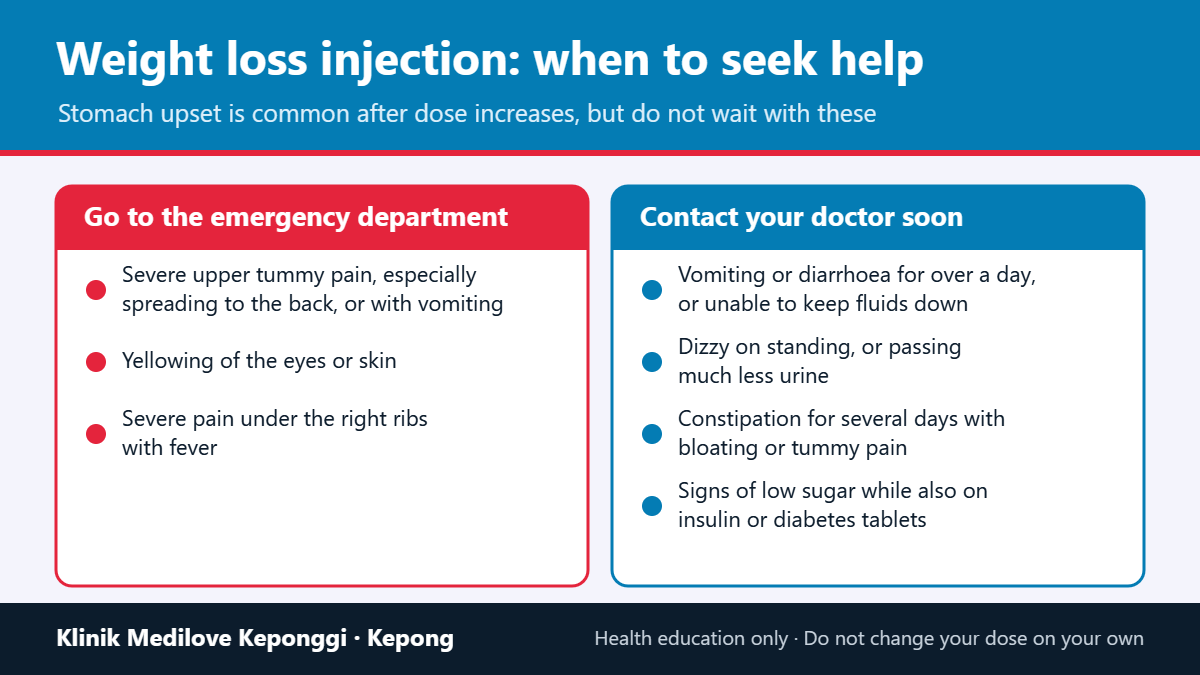
- severe pain in the upper tummy, especially if it spreads to your back or comes with vomiting
- yellowing of your eyes or skin
- severe pain under your right ribs with fever
Contact your doctor promptly if you have vomiting or diarrhoea lasting more than a day or can’t keep fluids down; dizziness on standing or passing much less urine; constipation for several days with bloating or pain; or symptoms of low blood sugar (shaking, sweating, confusion) while also taking insulin or diabetes tablets.
Pregnancy and contraception: tirzepatide is not recommended in pregnancy, so tell your doctor if you are pregnant, might be, or are planning a pregnancy. If you take the oral contraceptive pill, the prescribing information advises switching to a non-oral method or adding a barrier method (such as condoms) for 4 weeks after starting and for 4 weeks after each dose increase.
Common questions
How long does Mounjaro take to work for weight loss?
Most people notice less hunger within the first few weeks, but weight loss builds over months. The dose is stepped up every 4 weeks or more, and in trials weight kept falling over more than a year. Response is fairly judged after 6 months on your highest tolerated dose, not in the first month.
Should I increase my dose if I’m not losing weight?
Not on your own. A higher dose may help some people, but it can bring more side effects, and some people do well on a lower dose. Bring your 2-week record to your doctor and decide together.
Why did my friend lose more weight than me on the same dose?
Response varies a lot. Diabetes, other medicines, sex, starting weight, missed doses, drinks and snacks, and sleep all affect it. Compare yourself with where you started, not with someone else.
I’ve stopped losing weight after a few months. Is that normal?
Yes. Weight loss slows on every treatment, and plateaus are expected. It’s a good time to review your dose, protein and activity with your doctor rather than a sign that Mounjaro has stopped working.
Is the 5% rule the same as losing 5% in the first month?
No. NICE’s 5% mark is a treatment-review point after 6 months on your highest tolerated dose. Losing less than 5% in the first few weeks, while the dose is still going up, is common.
Is my Mounjaro fake?
Genuine Mounjaro in Malaysia comes with a prescription from a licensed clinic or pharmacy, with a MAL registration number and a FarmaTag hologram on the box. Be very cautious with vials, “research” peptides or cheap pens sold online. If unsure, bring the box to your doctor or pharmacist.
Can heat really stop Mounjaro working?
It can. Unused pens belong in the fridge, and a pen out of the fridge should stay below 30°C. Don’t leave pens in the car, near a window or in a hot bag.
Will I regain weight if I stop?
Many people do. In a large trial, most people who stopped regained a good part of the weight they had lost within a year. If you want to stop, plan it with your doctor so a maintenance plan is in place.
Weight loss injection not working? Book a review
If your weight loss injection is not working as you hoped, the next step is usually a review rather than a bigger dose. Bring your checklist, your pen box and your medicine list. We’ll look at your dose history, weight and waist trend, blood tests and other medicines, and agree a plan with you — without pressure to increase treatment.
You may also find these helpful:
- Medical Weight Management in Kepong: More Than Dieting, More Than Injections
- GLP-1 Weight Loss Injection: When Is It Actually Worth Considering?
- Medical Weight Management in Malaysia: Why Your Plan Should Be Personalised
Klinik Medilove Keponggi
Lot C-08-G, KepongGi, Jalan Rimbunan Teratai 1, 52100 Kepong, Kuala Lumpur · beside Taman Metropolitan Kepong
Phone / WhatsApp: 011-1560 7148
Mon–Fri 8:00am–9:00pm · Sat–Sun 8:00am–6:00pm
- This article is general health information and does not replace a personal consultation.
- Mounjaro is a prescription-only medicine. Do not start, stop or change the dose of any medicine without advice from your doctor.
- Clinical basis: NICE NG246 and TA1026; American Diabetes Association Standards of Care in Overweight and Obesity (2026); Obesity Canada Adult Clinical Practice Guideline (2025); WHO GLP-1 guideline (2025); Malaysian CPG Management of Obesity (2023); SURMOUNT-1, -2 and -4 trials; Mounjaro prescribing information.
- Last reviewed: 29 October 2026. Clinical content verified and reviewed.