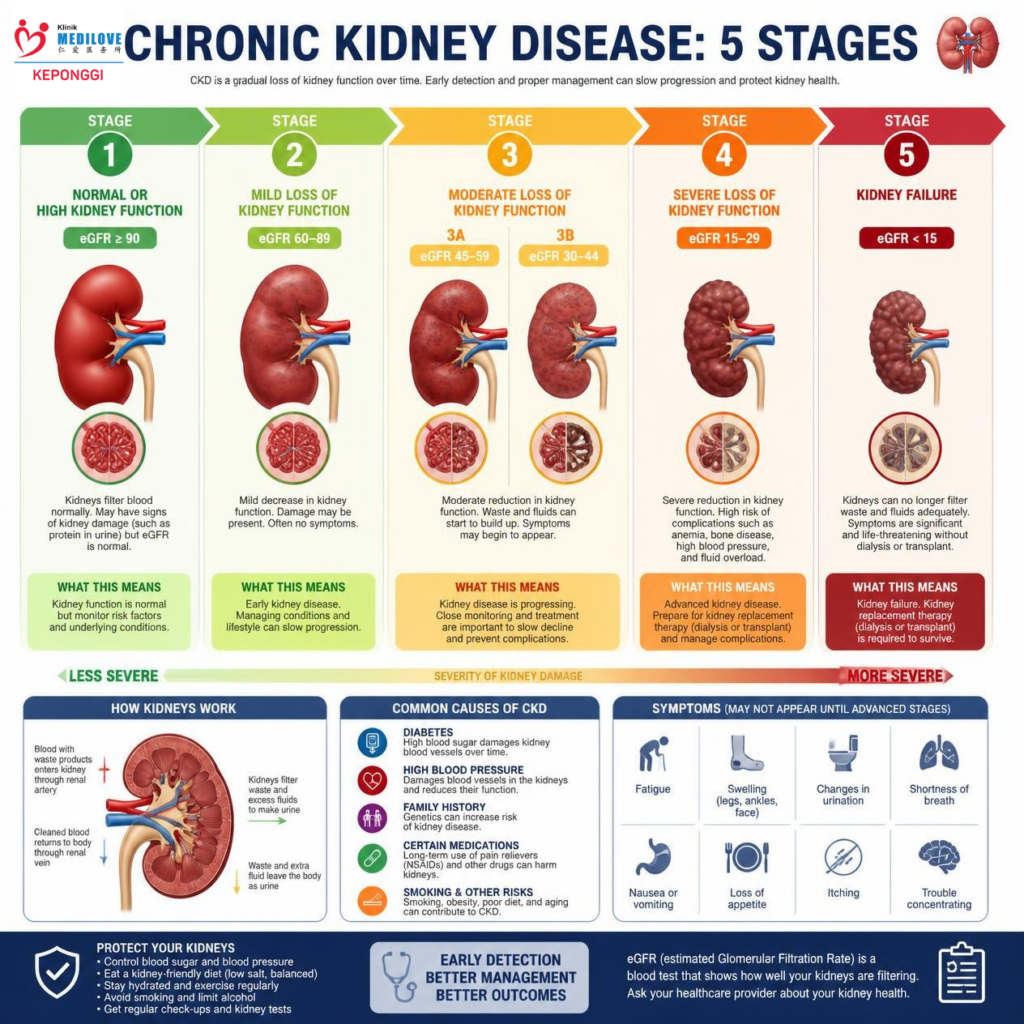
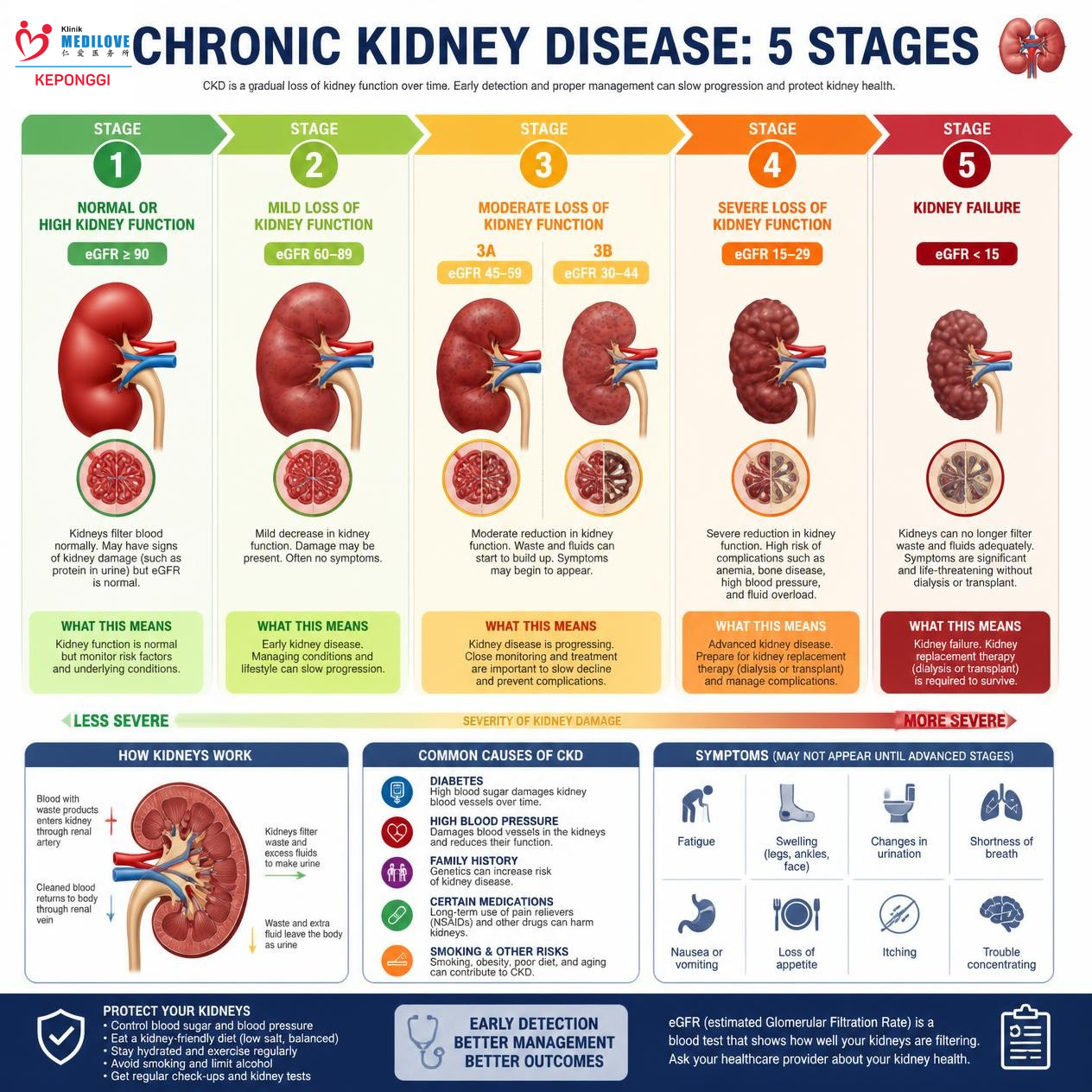
Chronic kidney disease (CKD) means your kidneys are damaged and cannot filter your blood as well as they should. CKD usually happens slowly over months to years and is divided into five stages (Stage 1–5) based mainly on your eGFR (estimated glomerular filtration rate).
Knowing your CKD stages help you and your doctor decide:
When to see a kidney specialist (nephrologist)
How often to check your kidneys
What medicines and lifestyle changes you need
What is Chronic Kidney Disease
CKD is long-term kidney damage that lasts at least 3 months. Common causes in Malaysia include diabetes, high blood pressure (hypertension), and glomerulonephritis.
Many people in early CKD have no symptoms. That’s why blood and urine tests are important, especially if you have diabetes or high blood pressure.
How do doctors stage CKD?
2 main tests:
Blood test:eGFR – how well your kidneys filter waste
Urine test : ACR or PCR- measures protein in urine, a sign of kidney damage.
CKD is confirmed when abnormal results are present for 3 months or more.
eGFR: your kidney filtration number
Your eGFR is calculated from your blood creatinine level, age, and sex. It estimates how much blood your kidneys filter each minute.
Typical eGFR ranges:
eGFR ≥ 90: normal or high filtration
eGFR 60–89: mild decrease
eGFR 45–59: mild–moderate decrease
eGFR 30–44: moderate–severe decrease
eGFR 15–29: severe decrease
eGFR < 15: kidney failure (may need dialysis or transplant)
A single low eGFR does not always mean CKD; it must be persistent over time.
Urine protein (ACR/PCR): sign of kidney damage
Even if eGFR is normal, protein in urine (albuminuria) means there is kidney damage and a higher risk of CKD getting worse.
ACR (albumin-to-creatinine ratio) or PCR (protein-to-creatinine ratio) are used to measure this.kidney
Higher levels of protein in urine indicate more severe kidney damage and higher cardiovascular risk.davita.com
This is why both eGFR and urine protein tests are needed to fully assess CKD
What each CKD Stages mean for you
Stage & eGFR
Key Focus & Follow-up
Stage G1-G2 eGFR ≽60
Kidneys still filter reasonably well, but there is evidence of damage.
• Focus: Control diabetes/blood pressure, avoid kidney-harming drugs.
• Follow-up: Every 6–12 months.
Stage G3a–G3b
eGFR 30–59
Moderate reduction in function; higher risk of anaemia and heart disease.
• Focus: Tighter control of blood pressure, sugar, and cholesterol.
• Follow-up: Every 3–6 months.
Stage G5 eGFR < 15
Kidney failure. Kidneys can no longer sustain life on their own.
• Focus: Dialysis or a kidney transplant managed closely by a specialist team.
• Follow-up: As advised by your specialist.
When to see a doctor in Kepong /KL?
You should see a doctor soon if you have :
Diabetes, high blood pressure, or a family history of kidney disease and have not been screened.
abnormal blood or urine test suggesting CKD.
We can refer you to see nephrologist ( kidney specialist) early if you have :
eGFR < 30 ( stage G4-G5)
Heavy or persistent protein in urine despite treatment
Rapidly worsening kidney function or difficult-to-control blood pressure
At Medilove Keponggi Clinic, we can:
arrange blood and urine tests for eGFR and protein
Review your medicine and risk factors
titrating the appropriate dose of medicine according to your kidney functions
coordinate referral to a kidney specialist and co-manage and follow-up your condition closely.
Frequently asked questions (FAQ)
1. Can CKD be cured?
Most CKD cannot be “cured”, but its progression can often be slowed or stopped with good control of diabetes, blood pressure, and lifestyle.
Q2: Do I need to see a specialist at Stage 1–2?
Not always. Many patients are managed by their GP with regular monitoring. Referral depends on protein in urine, cause of CKD, and how fast it is changing.
Q3: How often should I check my kidneys?
It depends on the stage and risk factors of CKD condition. Generally, Stage G1–G2: every 6–12 months Stage G3: every 3–6 months Stage G4–G5: every 1–3 months or as advised by your specialis
Q4: Can lifestyle changes really help?
Definitely. Namingly stopping smoking, maintaining a healthy weight, reducing salt, exercising regularly, and controlling diabetes and blood pressure can significantly slow CKD progression.