Respiratory health · Haze protection · October 2026
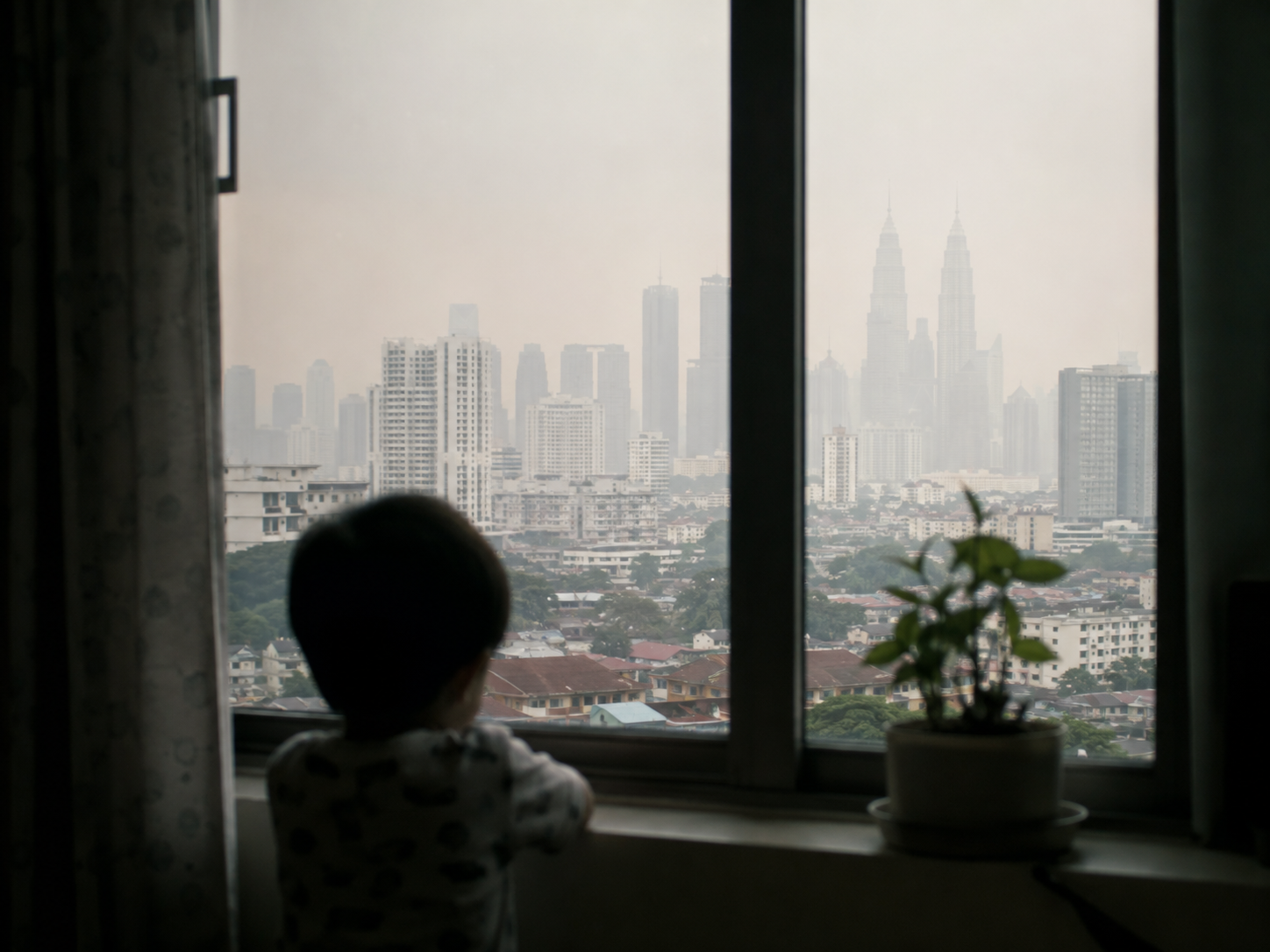
The haze in Malaysia is back. Its fine particles, called PM2.5, reach deep into the lungs and affect the heart as well as the chest.
Since early October, dozens of areas across the country have recorded “unhealthy” Air Pollutant Index (API) readings. At 9am on 20 October, the Batu Muda station – the one closest to Kepong – read 172, the highest in Malaysia at the time.
At Klinik Medilove Keponggi we are seeing more patients with dry cough, sore throat, asthma flare-ups and allergic rhinitis (hay fever-type symptoms).
This guide explains what PM2.5 is, who needs extra protection, which mask actually works, the Ministry of Health’s 7 steps, and when to see a doctor.
Staying indoors with the windows shut is one of the most effective ways to breathe in less PM2.5.
What is PM2.5, and why does haze in Malaysia affect your health?
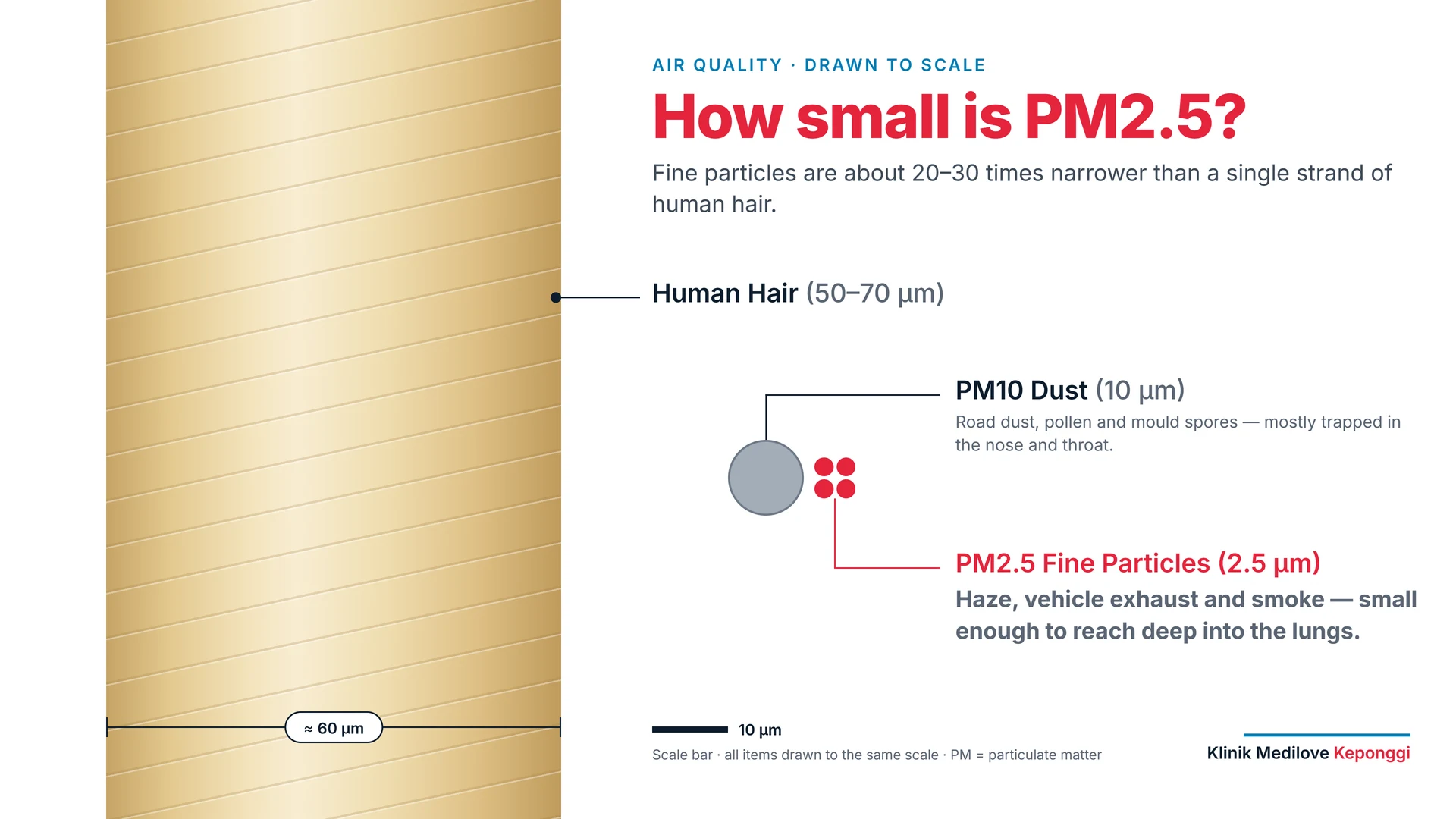
The most harmful part of haze is PM2.5: particles 2.5 micrometres across or smaller. A human hair is about 70 micrometres wide – roughly 30 times larger.
Drawn to scale: PM2.5 particles are about 20–30 times narrower than a human hair.
Hard to stop: the particles are so small that your nose and throat cannot filter them out.
Deep into the lungs: PM2.5 reaches the smallest airways, and some passes into the bloodstream.
Heart and lungs: the World Health Organization (WHO) says PM2.5 mainly affects the respiratory and cardiovascular systems. It is linked to a higher risk of chest infections, chronic obstructive pulmonary disease (COPD), heart disease and stroke.
In the short term, breathing in a lot of PM2.5 commonly causes gritty eyes, a runny nose, a sore throat and a cough. It can also set off asthma or allergic rhinitis.
Know your number: what the API means
The Air Pollutant Index (API) is published every hour by the Department of Environment (DOE) on the APIMS website ↗ and in its official MyJAS EQMS app. During haze, the reading is driven mainly by PM2.5.
API
Band
What it means for you
0–50
Good
Normal activity.
51–100
Moderate
Most people carry on as normal. If you have asthma, heart or lung disease, watch for symptoms and cut down long spells of outdoor exertion.
101–200
Unhealthy
Reduce outdoor physical activity. Wear an N95 if you must go out. Schools, nurseries and elderly-care centres must stop outdoor and co-curricular activities.
201–300
Very unhealthy
Avoid going out. Schools and nurseries must close, and outdoor activities and public gatherings must stop.
Above 300
Hazardous
Stay indoors with the windows shut.
The school and activity rules above follow the Ministry of Health’s October 2026 directives. They may change, so check the latest announcements.
Check the station nearest you, not the national headline. Kepong and Batu Caves residents should look at Batu Muda.
Who needs to take this more seriously?
Haze bothers everyone, but for these groups it can be a medical problem rather than an inconvenience:
Children: they breathe faster for their size, and their lungs are still developing.
Older adults: especially those with heart disease, a previous stroke or reduced lung function.
People with asthma, COPD or bronchiectasis: PM2.5 is a common trigger for flare-ups, sometimes a day or two after the worst readings.
Pregnant women: research links air pollution to effects on pregnancy and birth outcomes, so it is worth being cautious without being frightened.
People with diabetes or chronic kidney disease: these conditions already strain the blood vessels that fine particles inflame.
Outdoor workers: long hours in polluted air. The Ministry of Health has told employers to provide N95 masks for staff who work outdoors.
N95 vs surgical mask: which one filters PM2.5?
The Ministry of Health says the N95 is the most effective mask for filtering PM2.5 during haze. An N95 filters out at least 95% of very small (0.3-micron) particles and is designed to seal against your face.
A surgical (3-ply) mask is designed to catch droplets. Its loose edges let unfiltered air in at the sides, so it gives limited protection against PM2.5. If you cannot get an N95, the Ministry says a 3-ply mask can be used as an extra measure, but its protection is limited.
Surgical (3-ply) mask
N95 / KN95 / KF94
Designed for
Catching droplets
Filtering fine particles
0.3-micron particles
Leaks at the sides; limited protection
N95: at least 95% filtered
Fit
Loose
Seals against the face
When to use
Limited stand-in if no N95 is available
Going out when the API is above 100; higher-risk groups
How much does a mask really block on your face?
Out of every 100 fine particles, roughly how many get breathed in (tested on volunteers)
Surgical (3-ply) mask
About 10–40 get in
Tested on 20 volunteers, none of the surgical masks fitted well enough to count as respiratory protection.
About 5 times more particles leaked in around the edges than through the mask material.
N95 respirator (well fitted)
Under 10 for most people get in
The N95 filter material itself stops at least 95% of 0.3-micron particles.
Worn on the face, it gave 8–12 times more protection than surgical masks on average.
But about 3 in 10 N95s gave less protection than expected because of poor fit – so the seal matters.
Gets inDepends on fitBlocked
Sources: Oberg & Brosseau (2008), Lee et al. (2008), Grinshpun et al. (2009), Understanding Filtering Facepiece Respirators (2022). These were laboratory studies with volunteers wearing masks and test particles of about 0.03–3 microns, not measurements in real haze. Real-world protection varies with the mask model, size and fit.
Getting the N95 right
The seal is everything: cover your nose and chin and press the nose clip down. The mask should pull in slightly when you breathe in, with no air leaking at the sides.
Beards break the seal: facial hair stops the mask fitting properly and reduces protection.
Children: adult N95s are too big for small faces, and masks are only recommended for children aged 2 and over. For a young child, keeping them indoors works better than relying on a mask.
It makes breathing harder: if you have heart or lung disease, ask your doctor before using one. If you feel breathless or dizzy, take it off and go indoors.
When to replace it: when it is dirty, damp or out of shape, or when it becomes hard to breathe through.
KKM’s 7 steps – and what we would add
The Ministry of Health (KKM) has a standard 7-step haze advisory. It is good advice. Here is how to put each step into practice.
1. Drink enough water
KKM suggests at least 8 glasses a day. Water does not “flush out” particles – nothing does – but it keeps your nose and throat moist, which eases irritation and helps you clear mucus. If you have heart failure or advanced kidney disease and have been given a fluid limit, keep to that limit.
2. Limit outdoor activity
This is the step that does the most work. The Ministry says avoiding outdoor activity is the most effective way to reduce the effects of haze when the API is above 100.
Above API 100, move exercise indoors. You breathe harder and deeper when you run, so you take in far more particles.
For children with asthma, we would keep them in from about API 100, rather than waiting for schools to close.
Particles settle on skin, hair and eyelashes. Rubbing hazy eyes with unwashed hands can turn irritation into conjunctivitis. Rinse gritty eyes with clean water or lubricating eye drops, and avoid steroid or “red-eye” drops unless a doctor has prescribed them.
5. Clean up your indoor air
Keep windows and doors shut. Set air-conditioning to recirculate if it has the option, and clean the filter.
Make one “clean room”: run a HEPA air purifier in the room where the most vulnerable person in the household sleeps, and keep the door closed.
Choose a purifier with a clean air delivery rate (CADR) big enough for the room, and avoid devices that produce ozone. Some ionisers can also give off ozone.
Do not burn incense, mosquito coils or candles indoors, and cut down on frying and grilling – they add particles to the room you are trying to clear.
6. Do not smoke – especially indoors
A cigarette indoors during haze adds even more particles to the air your family breathes. Vaping is not a safe substitute.
7. In the car, use recirculation mode
Press the button with the arrow looping inside the car outline. It stops the cabin drawing in roadside air. Air-con on, recirculation on, windows up.
If you have asthma or COPD: 3 things to do today
Check your reliever inhaler (usually the blue salbutamol one) is in date and in your bag.
Keep taking your preventer every day, even if you feel fine. This is not the week to skip doses.
Know your action plan. If you need your reliever more than every 4 hours, or it is not lasting, that is a flare-up, not haze irritation. Come in to see us, or go to the nearest emergency department if you are struggling to speak in full sentences.
If you do not have a written asthma action plan, that alone is worth a short visit.
When to see a doctor
A dry cough, scratchy throat, watery or gritty eyes and a runny nose are the usual effects of breathing smoke. They are unpleasant, not dangerous, and settle once the air clears.
See a doctor within a day or two if you have:
a cough lasting more than a week
wheezing or a tight chest
a cough that keeps you or your child awake at night
a fever with the cough
eyes that are red, sticky or painful rather than just irritated
Children should be seen the same day if they become unusually quiet, breathe faster than normal, or are eating and drinking less.
Go to the nearest emergency department or call 999 immediately if there is:
difficulty breathing, or breathing that is getting faster
blue or grey lips
inability to speak in full sentences
chest pain or pressure
confusion or drowsiness
a reliever inhaler that is not working
a child whose ribs pull in with each breath
Do not wait for the haze to clear.
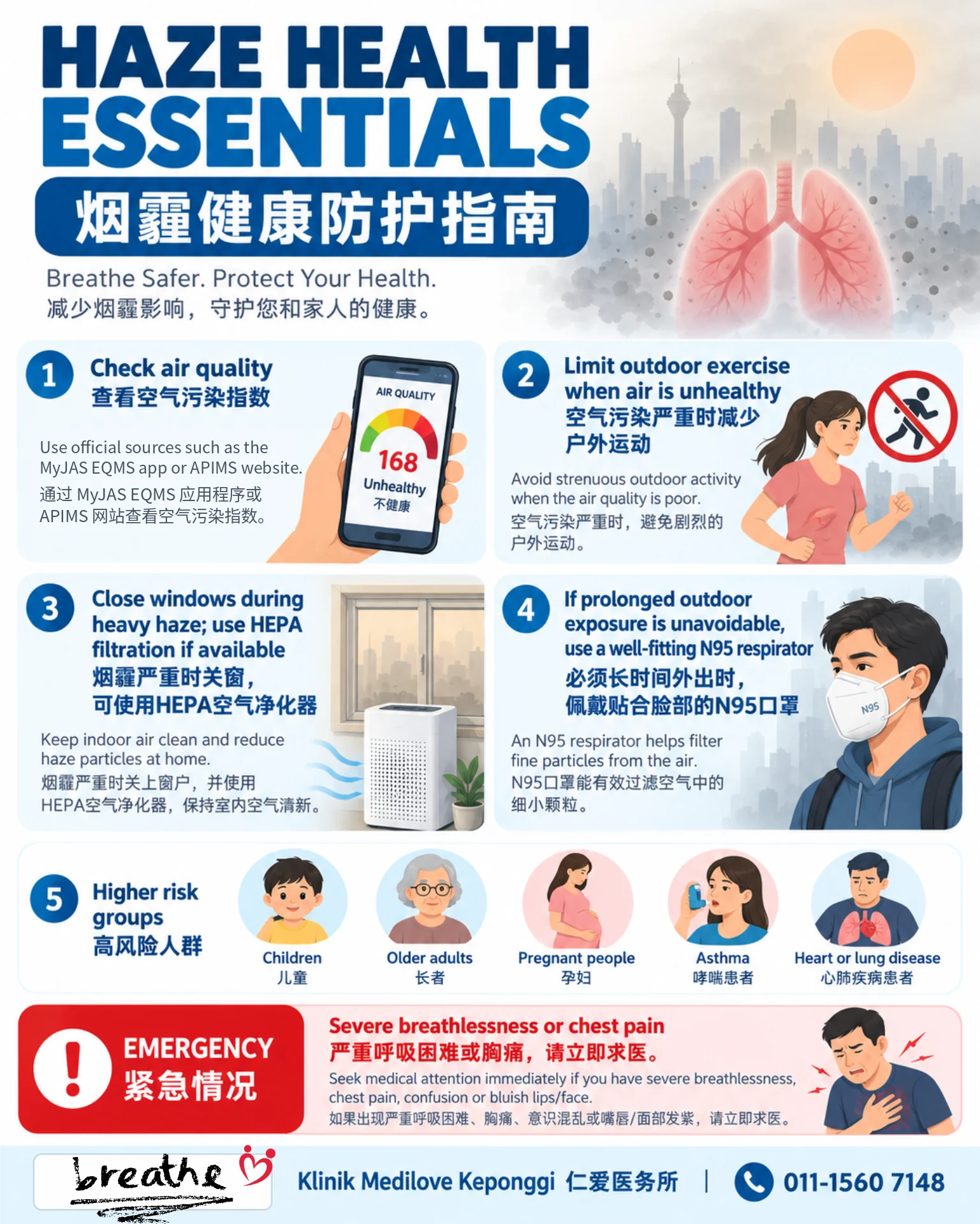
At a glance: 5 ways to protect your family during haze, and when to get help immediately.
Frequently asked questions
Is a surgical mask useless?
No, but its protection is limited. It catches droplets well, but air leaks in at the sides, so most PM2.5 gets through. Use one only if you cannot get an N95, and spend less time outdoors.
Is a KN95 or KF94 as good as an N95?
When they are genuine and fitted well, they filter fine particles comparably. The weak point is the seal: ear-loop masks tend to seal less tightly than head-strap N95s. Any of them is far better than a surgical mask for haze.
Can my child wear a mask?
Only from age 2. Never put a mask on a child under 2. Adult N95s do not fit small faces, so for young children, staying indoors works better. If your child does wear one, choose a size that covers the nose and chin.
Can an N95 be reused?
N95s are generally disposable. Replace yours when it is dirty, damp or out of shape, or when it becomes hard to breathe through.
Does drinking more water or eating certain foods protect the lungs?
Water helps with throat and eye irritation, and a normal diet with fruit and vegetables is sensible. But no food or supplement removes particles from the lungs. Reducing exposure is the only thing that works.
Should I stop my morning walk?
Above API 100, yes – or move it indoors or to a mall. If you have heart or lung disease, do so above API 50. Early morning is often the worst time during haze, and midday readings are sometimes lower.
Is it safe to keep the fan on and the windows open at night?
Not on an unhealthy day. A fan simply moves outdoor air around the room. Close the windows, and use air-conditioning or a purifier if you have one. A fan with the windows shut is still better than open windows.
How do I choose an air purifier?
Choose one with a HEPA filter and a clean air delivery rate (CADR) big enough for the room, and change the filter as the maker recommends. Avoid devices that produce ozone.
The honest summary
Of KKM’s 7 steps, 2 do most of the work: stay indoors with the windows closed as much as you reasonably can, and if you must go out, wear an N95 that actually seals. If you have asthma or COPD, keep your inhalers within reach and keep taking your preventer.
One small thing to do today: check the API reading at the station nearest your home.
Klinik Medilove Keponggi: haze-related symptoms
If you or your family have a cough that is not settling, a sore throat, worsening allergic rhinitis, or asthma that is harder to control, come and see a doctor at Klinik Medilove Keponggi. We will review your symptoms, adjust treatment if needed, and refer you on if necessary.
Address: Lot C-08-G, KepongGi, Jalan Rimbunan Teratai 1, 52100 Kepong, Kuala Lumpur (beside Taman Metropolitan Kepong)