









Medical Weight Management in Kepong: More Than Dieting, More Than Injections

A typical story we hear in Kepong goes something like this. : Breakfast is roti bakar and kopi at the kopitiam. Lunch is economy rice near the office, with a full plate of rice because “the lauk is salty”. The drive home along Jalan Kepong or the MRR2 takes an hour. Dinner is tapau or delivery because nobody has energy to cook. On a good week, there is supper at the mamak with friends. On a bad week, there is a family-business shift that finishes at 10pm and a packet of biscuits at midnight.
Most people already know that overweight/obesity is a chronic issue in Malaysia. What they want is a plan that fits a real Kepong life — not another diet sheet. That is what weight management should look like: medical, practical and personal.
It is not simply “eat less and exercise more”. And it is definitely not simply prescribing a weight-loss injection. Proper weight management starts by understanding why you are gaining weight, how that weight is affecting your health, what you have already tried, and which treatment is realistic enough to continue for years.
The National Health and Morbidity Survey 2023 found that 54.4% of Malaysian adults are overweight or living with obesity — 32.6% overweight and 21.8% living with obesity.
Abdominal obesity was just as common, at 54.5%.
When more than half of the country is affected, it is hard to explain it as millions of people suddenly lacking discipline. Something bigger is going on — in our biology, and in the way we eat, work and move.
First: obesity is not a willpower problem
Your body does not handle weight loss like a calculator. Body weight is shaped by appetite and fullness signals, genetics, sleep, stress, daily routine, physical activity, medications, medical conditions — and the food environment around you. In Kepong, that environment includes sweet drinks at every stall, generous rice portions, food delivery at any hour, this has become our daily challenges.
The World Health Organization describes obesity as a chronic, relapsing disease that needs long-term care. This does not mean lifestyle stops mattering. It means lifestyle is one part of the biology we are working with.
What is “medical weight management”?
Medical weight management is the comprehensive assessment and evidence-based treatment of overweight and obesity using nutrition, physical activity, behavioural intervention, management of comorbidities and, when appropriate, pharmacotherapy or metabolic surgery.
A proper programme usually involves:
- Medical assessment and weight history
- BMI and waist circumference measurement
- Body composition analysis
- Screening for metabolic conditions
- Individualised nutrition planning
- Exercise and muscle-preservation strategies
- Behavioural and lifestyle support
- Treatment of obesity-related conditions
- Prescription weight-loss medication when appropriate
- Regular follow-up and long-term weight maintenance
The goal is not simply to make the number on the weighing scale smaller. It is to improve body fat, visceral fat, muscle health, blood sugar, cholesterol, blood pressure, fatty liver risk and overall metabolic health.
What does my BMI mean in Malaysia?
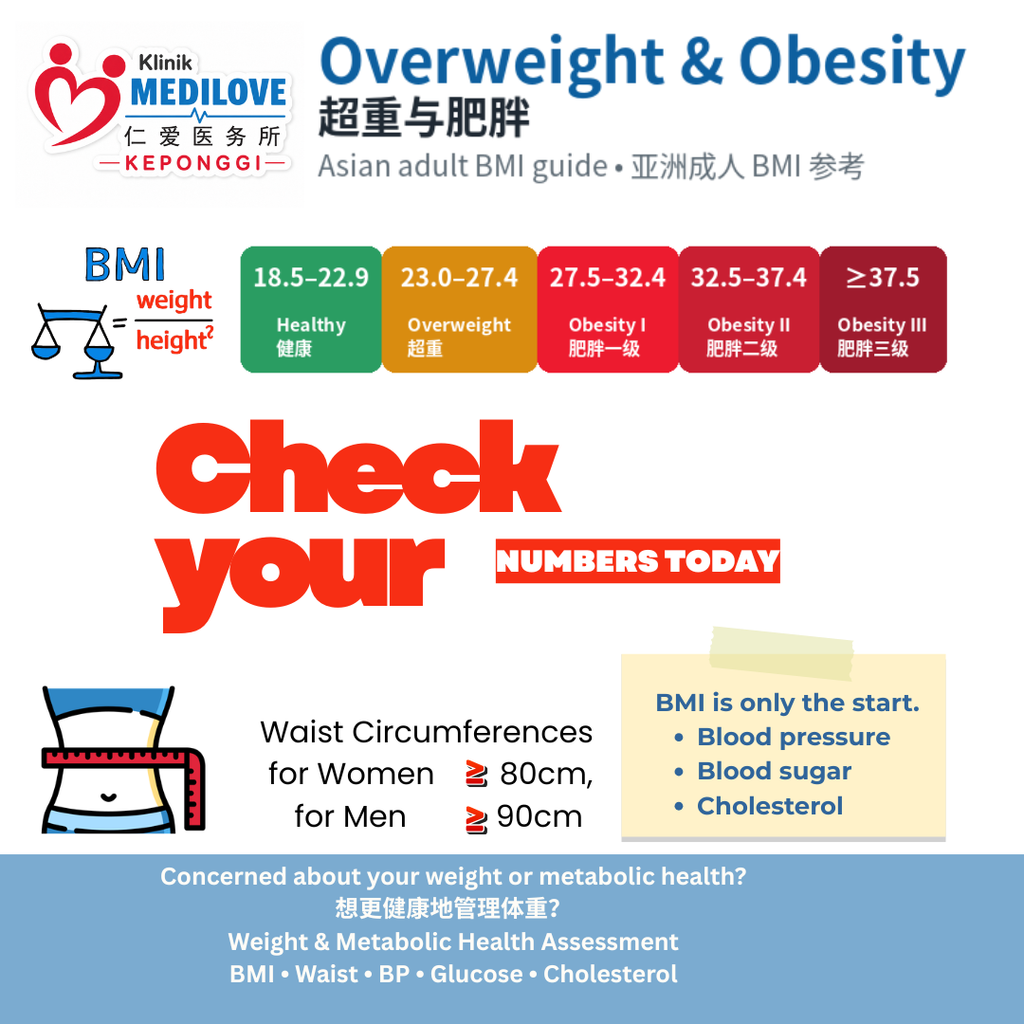
BMI compares weight with height:
BMI = weight (kg) ÷ height² (m)
Malaysia’s 2023 obesity guideline uses lower cut-offs for Asian adults, because problems like diabetes and high blood pressure appear at lower BMI in our population. Check your numbers: for Asian adults, health risk starts rising from a BMI of 23. BMI is only the start – waist size, blood pressure, blood sugar and cholesterol complete the picture.
| Classification | BMI (kg/m²) |
|---|---|
| normal | 18.5–22.9 |
| Overweight / pre-obese | 23.0–27.4 |
| Obesity Class I | 27.5–32.4 |
| Obesity Class II | 32.5–37.4 |
| Obesity Class III | ≥37.5 |
Many patients are surprised by this, because the international cut-off for obesity is 30. A BMI of 28 may sound “only a bit overweight” — in Malaysia, it is already classified as obesity.Still, BMI is a screening number. It cannot tell muscle from fat, and two people with the same BMI can have very different health risks. That is why we also measure the waist.
For Malaysian adults, a waist of 90 cm or more in men, or 80 cm or more in women, signals extra abdominal fat and higher metabolic risk. This is common in our community even at a “normal” BMI — the slim-looking uncle with a round tummy is a very Kepong picture.
The goal is not to become “thin”
A patient weighing 100 kg may walk in believing: “Unless I get to 65 kg, I have failed.”
Instead, we look for clinically meaningful improvement. The Malaysian guideline notes that a calorie-reduced diet combined with exercise typically achieves around 5–15% weight loss — for a 90 kg person, roughly 4.5 to 13.5 kg, not 30.
Even this modest amount can improve blood pressure, blood sugar, fatty liver, sleep apnoea and joint pain.
So the first question is not “What is my perfect weight?”
It is: “What amount of weight loss would meaningfully improve my health, and what is a realistic first milestone?”
Treatment has several levels
There is no single treatment that suits everyone.
Food — changes you can keep in Kepong
A good eating plan reduces excess energy while keeping enough nutrition and protein — in a pattern you can actually continue.
The Malaysian guideline recommends individualising diet to age, medical conditions, activity level, goals and preference. In practice, the biggest opportunity differs from person to person:
- Drinks. Two or three cups of kopi or teh tarik with condensed milk a day add up quickly. Moving to kurang manis (siew dai), then kopi-o kosong or teh-o kosong, is one of the easiest changes with the biggest payoff.
- Rice and noodle portions. At the economy rice stall, ask for half rice and add one more vegetable dish. Choose soup noodles over dry noodles tossed in oil and lard.
- The plate. MOH’s “Suku-Suku Separuh” (quarter-quarter-half) plate is a simple guide: half vegetables and fruit, a quarter rice or noodles, a quarter fish, chicken, egg, tofu or beans.
- Late nights. Mamak supper, midnight snacks after a late shift, and delivery apps that never close.
- Weekends and festivals. Dim sum breakfasts, family dinners and Chinese New Year are not “cheat days” to feel guilty about — they are part of life, and a good plan accounts for them.
The best starting point is usually not the strictest diet. It is the highest-impact change you can actually maintain.
We want to lose excess fat while keeping as much muscle as possible — especially in older adults, and during faster weight loss (including on medication). Strength exercise, enough protein and adequate nutrition help protect your strength and independence.
The goal is not just to become smaller. It is to become healthier and more capable
Physical activity improves heart fitness, insulin sensitivity, mood, mobility and long-term weight maintenance — not just calorie burn.
Sleep, stress and eating behaviour
A person sleeping five hours, working late in the family shop, drinking sweet coffee to stay awake and eating supper at midnight has a very different weight problem from someone with a regular 9-to-5 routine.
Some people eat mainly from hunger. Others struggle with stress eating, boredom eating, binge eating, cravings, social eating, or what many patients describe as constant “food noise” — food occupying their thoughts even when they are trying not to eat.
When should weight-loss medication be considered?
Prescription medication can be a legitimate part of obesity treatment for the right patient.
Malaysia’s 2023 obesity guideline says medication should be used together with lifestyle treatment, not instead of it, and considered when lifestyle measures alone have not achieved enough weight loss or maintenance. The guideline’s thresholds are:
- BMI ≥30 kg/m², or
- BMI ≥27 kg/m² with a weight-related condition, such as type 2 diabetes, high blood pressure, high cholesterol or sleep apnoea
Notice that these are not the same as the BMI classification above. A BMI of 27.5 meets the Malaysian definition of obesity, but it does not automatically mean you should start medication. We still weigh up your health risk, previous attempts, possible side effects, expectations, cost and preference.
And no — weight-loss medicine is not “cheating”
If someone takes medicine for high blood pressure, nobody accuses them of cheating.
The same logic applies to obesity. Modern weight-management medicines act on the body’s hunger and fullness pathways. In December 2025, WHO issued its first guideline on GLP-1 medicines for obesity, conditionally recommending them for long-term treatment in adults — alongside healthy diet and physical activity support, not as a standalone fix.
But these are not cosmetic products either. They have indications, side effects, contraindications, costs and monitoring needs, and they are not meant for a healthy person who simply wants to be a few kilograms lighter.
A word of caution specific to 2026: many “pen kurus” and “Reta” vials sold on TikTok, Xiaohongshu and Facebook are not registered in Malaysia. Please read [Retatrutide in Malaysia: Why KKM Says Don’t Buy Reta Online](⟦confirm live URL⟧) before buying anything online.
For more on who might benefit from these medicines, read GLP-1 Weight Loss Injection: When Is It Actually Worth Considering?
“Can I stop once I reach my target?”
Worth discussing before starting treatment.
Obesity behaves like other chronic conditions. When an effective treatment stops, the biological drive towards weight gain may still be there. Some people keep their progress; others find hunger returns and weight creeps back.
That does not mean treatment was pointless. It means maintenance needs its own plan — food, activity, muscle, habits, medication duration if relevant, cost, and follow-up.
A plateau doesn’t mean it has stopped working
Everyone hopes for 100 kg → 95 → 90 → 85 → 80.
Real life is messier. There will be weeks when nothing moves — a busy month at work, a family wedding, Chinese New Year, a bout of flu.
A plateau may mean the body has adjusted to a lower weight, or that the plan needs a tweak. Instead of “the diet stopped working”, the more useful question is:
“What has changed, and what is the next adjustment?”
The scale is not the only measure of success
Imagine someone loses only a modest amount of weight, but:
- their HbA1c improves
- their blood pressure falls
- their waist gets smaller
- they stop snoring
- they can walk up the MRT station stairs without stopping
- their knee pain eases
- and they are now walking three evenings a week
Was that treatment unsuccessful? Of course not. Depending on the person, we may track weight, waist, blood pressure, glucose or HbA1c, cholesterol, liver health, sleep, fitness and quality of life. The scale matters. It is not the whole story.
What about bariatric (metabolic) surgery?
For selected people with severe obesity who have not responded to medical treatment, bariatric or metabolic surgery is an evidence-based option recognised in the Malaysian guideline.
What happens at a weight-management consultation?
You should leave understanding more than your BMI. A useful assessment answers four questions:
- What is contributing to my weight?
- Is my weight already affecting my health?
- Which treatment options are reasonable for me?
- What will we monitor to know whether it is working?
Blood tests for sugar, cholesterol, liver and kidney function are often part of this — see [Health Screening in Kepong: Do You Really Need One? for what these tests can and cannot tell you.
The plan may involve food changes, activity, sleep, behaviour strategies, treating related conditions, prescription medicine, referral to a dietitian or specialist, or occasionally discussing surgery. Different people need different levels of treatment.
One final thought
If weight were simply about knowing that vegetables are healthier than char kuey teow, most people would have solved it years ago.
Most patients already know what they are “supposed” to do. The harder questions are:
- Why am I always hungry?
- Why do I keep regaining?
- Why is this harder now than ten years ago?
- Is my weight affecting my health yet?
- Do I need medication?
- How much do I actually need to lose?
- How do I keep it off?
Those are medical weight-management questions — and they are far more useful than being told, once again, “You need to lose weight.”