





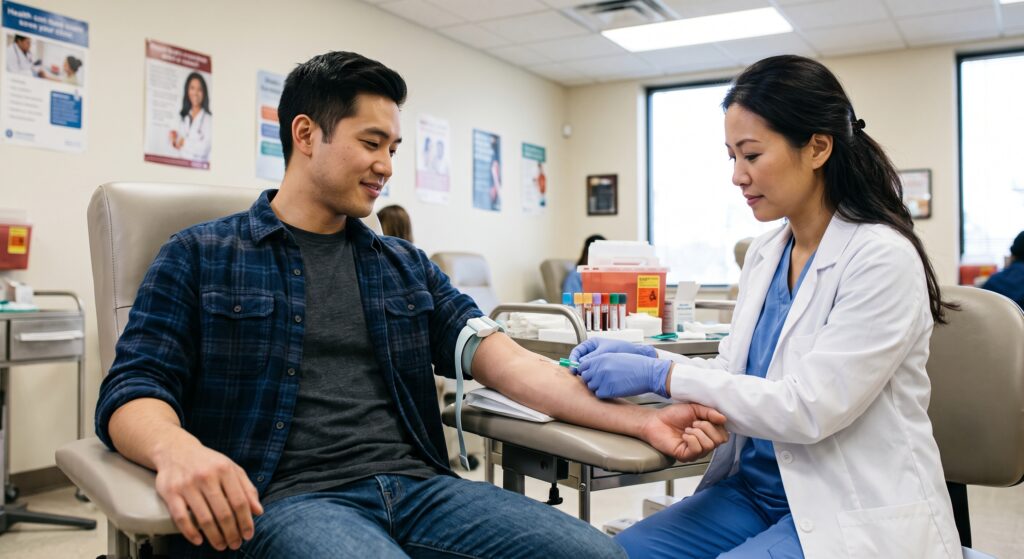
“They couldn’t find my vein, poked me twice, and I nearly fainted. Now I avoid blood tests.”
We hear this often at the counter. Some people put off a health screening for months just because of the needle. If that sounds like you, you are not being dramatic — and there is quite a lot you can do about it.
The needle itself usually hurts for a few seconds. What makes a blood test feel worse is everything around it: veins that are hard to find, a second attempt, a tense arm, an empty stomach, and the dread beforehand. This guide covers the simple steps that make a less painful blood test more likely — before you arrive, while the needle is in, and afterwards — plus what helps children.
Why some blood tests hurt more than others
A few things make a blood draw more uncomfortable:
- Veins that are hard to see or feel. Cold, dehydration and small veins all make the vein harder to find, which can mean more searching or a second poke.
- Tension and fear. A tight, braced arm and a racing mind make the same needle feel sharper.
- Feeling faint. Some people have a sudden drop in heart rate and blood pressure at the sight or thought of a needle. This is called a vasovagal reaction. It is common, it is not dangerous in itself, and it can be planned for.
Most of these are things you can influence.
Before your blood test
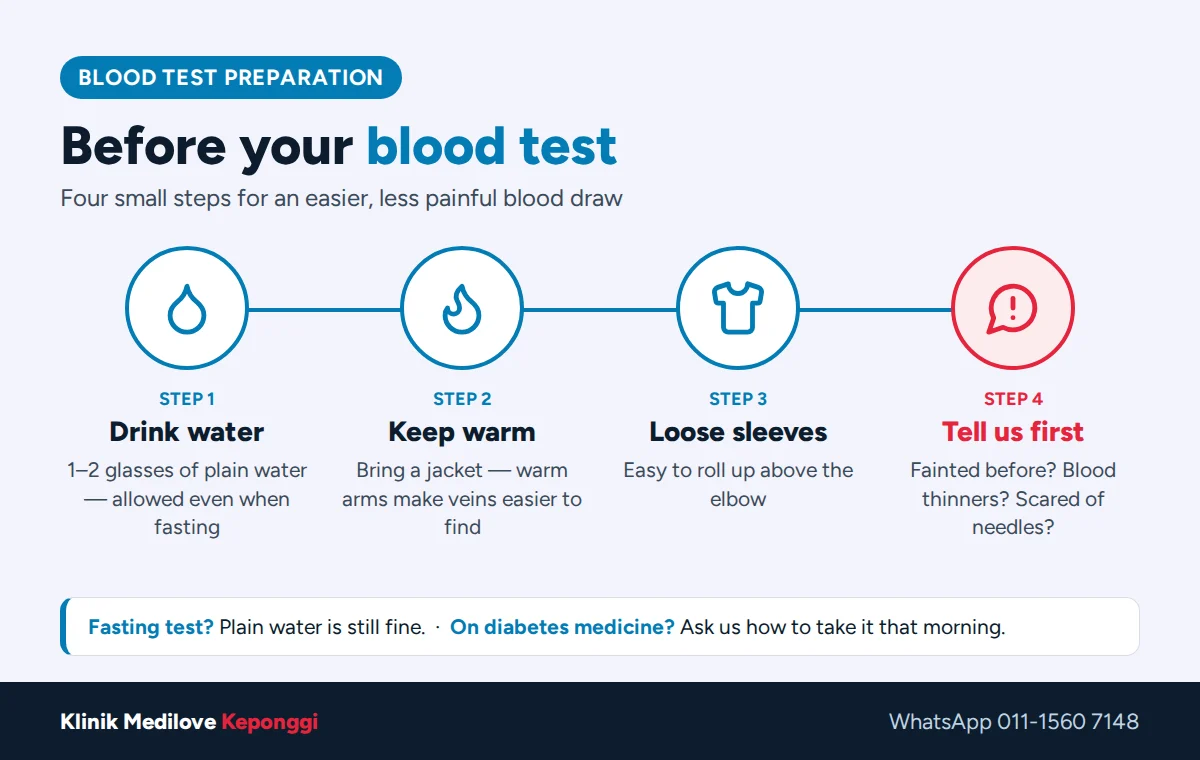
Drink some water
Unless your doctor has told you to limit fluids — for example, in heart failure or advanced kidney disease — drink a glass or two of plain water in the hour or two before your test. Water is allowed even before a fasting blood test; fasting means no food, tea, coffee or sweet drinks, not no water.
In blood donor studies, drinking about 500 ml of water beforehand slightly reduced fainting reactions. The effect is modest, but water costs nothing and it helps you feel better on an empty stomach.
If you have diabetes and are asked to fast, check with your doctor how to take your diabetes medicines that morning.
Keep your arms warm
Warm skin opens up the veins. In a hospital study, warming the hand and forearm before inserting a drip made it more likely to succeed on the first attempt.
In Kepong, the weather outside is hot but clinic air-conditioning is not. Bring a light jacket or long sleeves for the waiting area, keep your hands in your pockets, or hold a warm drink bottle.
Eat if you are allowed to
If your test is not a fasting test, have a normal meal beforehand. An empty stomach makes feeling faint more likely. If it is a fasting test, book the earliest slot you can and bring something to eat afterwards.
Wear the right clothes
Choose short sleeves or loose sleeves that roll up easily above the elbow. A tight sleeve bunched around the upper arm gets in the way.
Tell the staff before they start
This one step makes a real difference. Before the needle comes out, mention any of these:
- “I have fainted before during a blood test.” We can let you lie down, which is the simplest way to stop a faint before it happens.
- “My veins are hard to find” or “this spot worked last time.” Your experience is useful information.
- “I’m taking a blood thinner” such as aspirin, warfarin or a newer anticoagulant. You will need to press for longer afterwards.
- “I’ve had breast surgery or lymph nodes removed on one side.” We will usually use the other arm.
- “I’m really scared of needles.” Saying it out loud is not a weakness. It helps us slow down and explain each step.
It also helps to ask your doctor whether all the tests you need can be taken in one draw, so you are not coming back for a second poke.
During the blood test: how to make it hurt less
Look away and distract yourself
Look at something else, talk to the person taking your blood, or scroll your phone with your free hand. Distraction is one of the best-studied ways to reduce needle pain, especially in children.
Try the “cough trick”
As the needle goes in, give one small cough. In a small study of adult volunteers, people reported less pain when they coughed at the moment of the needle. Ask the staff to say “now” so you can time it. A slow, long breath out works for some people too.
Keep the arm relaxed — and do not pump your fist
A relaxed arm hurts less than a braced one. You may be asked to make a gentle fist to help the vein stand out. Hold it gently; do not open and close your hand repeatedly.
Repeated fist pumping can push potassium out of the forearm muscles and give a falsely high potassium result. That can lead to unnecessary worry or a repeat test — the very thing you want to avoid.
If you tend to faint
- Lie down for the test. Ask for this from the start rather than waiting to feel dizzy.
- Use “applied muscle tension”. Tense the big muscles in your legs and buttocks for a few seconds, relax, and repeat several times. This helps keep your blood pressure up. Never tense the arm the blood is being taken from.
- Speak up early. If you feel hot, sweaty, sick or light-headed, say so straight away. The needle can come out and you can lie back with your legs raised.
Most of the research on these techniques comes from blood donors, who give far more blood than a routine test takes. The evidence shows a small benefit rather than a guarantee — but these steps are simple, safe and worth trying.
After the blood test: how to avoid a bruise
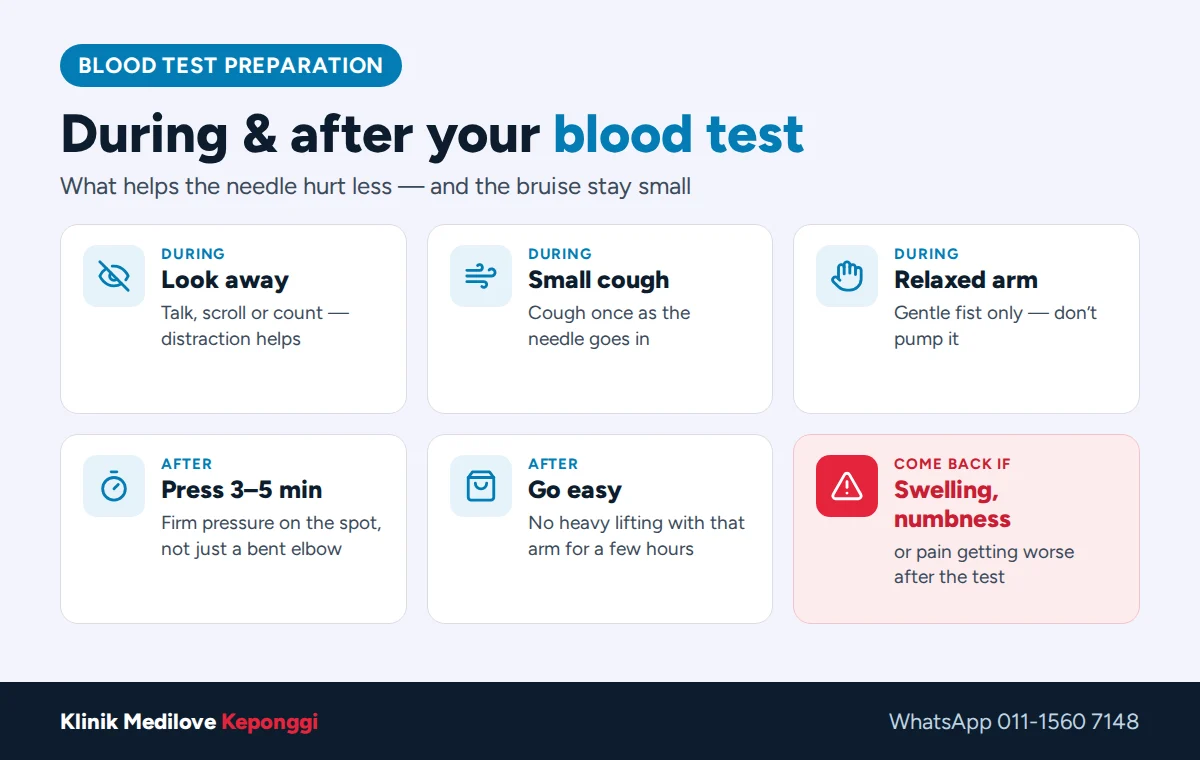
- Press firmly on the spot for 3 to 5 minutes, straight after the needle comes out. Press with your fingers directly over the cotton ball. Bending the elbow over the cotton is not a substitute for pressing — it does not put enough pressure on the actual spot.
- Press for longer if you take a blood thinner.
- Avoid heavy lifting with that arm for a few hours — shopping bags, a toddler, gym weights.
- If a bruise appears, a cold pack in the first day can ease it. Small bruises are common and usually fade on their own over a week or two.
- After a fasting test, eat and drink soon.
Numbing cream: who it is for
Numbing creams (for example, a lidocaine and prilocaine cream) work well, but they need to be applied well before the test — usually about an hour — under a covering dressing. They are most useful for children and for adults with strong needle fear.
Because of the timing, this needs planning. Ask your doctor or pharmacist before your appointment, and tell the clinic when you book, so the cream can be put on at the right place and the right time. Use it only as directed; babies and young children need particular care with the amount.
Blood tests for children
- Prepare honestly and briefly. “It will feel like a quick pinch, then it’s done.” Do not promise it won’t hurt.
- Use numbing cream if there is time to plan ahead.
- Distraction works. Bubbles, a video, a favourite toy, counting games, or “blow out the candles” breathing.
- Hold them comfortably, such as sitting upright on your lap in a hug.
- For babies, breastfeeding during the procedure, or a small dose of sugar solution given by staff, can help.
- Skip “you’re okay” and “sorry, sorry”. It sounds kind, but it can make children more distressed. Calm, normal conversation helps more.
When fear of needles is bigger than a few tips
For some people, needle fear is severe: they cancel tests, feel panicky days before, or have fainted many times. If that is you, tips alone may not be enough — and that is okay. A specific type of therapy that gradually and safely builds confidence with needles works well for high levels of needle fear. Talk to your doctor about it. Avoiding blood tests altogether can mean missing problems that are easy to treat when caught early.
Return, or contact your clinic, if after a blood test you notice:
- Swelling at the site that keeps getting bigger
- Numbness, tingling or a shooting pain down the arm or into the fingers
- Pain that is getting worse instead of better after a day or two
- Redness, warmth or pus at the site
These are uncommon, but they are worth checking.
Common questions
Can I drink water before a fasting blood test?
Yes. Plain water is allowed and can make the blood draw easier. Avoid tea, coffee, sweet drinks and food unless told otherwise.
Should I squeeze a stress ball during my blood test?
No. Make a gentle fist only when asked. Repeated squeezing can give a falsely high potassium result.
Is it normal to get a bruise after a blood test?
Yes, a small bruise is common and usually fades within a week or two. Pressing firmly for 3–5 minutes straight after the test makes one less likely.
Can I ask for a particular arm or vein?
Yes. Tell the staff which spot has worked before. They will check whether it is suitable.
I have fainted during a blood test before. Can I still do one?
Yes. Tell the staff first, lie down for the test, and use the leg-tensing exercise. Most people who faint once have no problem when it is planned for.
Can I use numbing cream?
Often, yes. It needs to go on about an hour before, so ask your doctor or pharmacist ahead of time and use it only as directed.
A less painful blood test in one minute
- Before: drink water and keep warm so the vein is easier to find.
- Tell us: if you have fainted before, take a blood thinner, or are very scared.
- During: look away, give a small cough as the needle goes in, and keep your arm relaxed without pumping your fist.
- After: press firmly on the spot for 3 to 5 minutes.
For the full checklist before a blood test (whether to fast, how to take your medicines, what to bring), see our blood test preparation guide. If needle fear is stopping you from having tests you need, tell your doctor. There is help for that too.
Questions? Contact us
Klinik Medilove Keponggi
Lot C-08-G (ground floor), KepongGi, Jalan Rimbunan Teratai 1, 52100 Kepong, Kuala Lumpur · beside Taman Metropolitan Kepong
Phone / WhatsApp: 011-1560 7148
Mon–Fri 8:00am–9:00pm · Sat–Sun 8:00am–6:00pm