
Women’s Health
Breast Cancer Awareness in Malaysia: Why Knowing Isn’t Enough
Breast cancer is the most common cancer among Malaysian women, yet many cases are still found late. Learn…
 Prediabetes: 4 Easy Exercises for Beginners
 Diabetes in Malaysia: Symptoms, Tests, Treatment and Prevention
 Weight Loss Injection Not Working? 9 Reasons and What to Do
 Why Can’t I Stop Overthinking at Night? A Doctor Explains
 Taking Charge of Your Health: Small Steps That Fit Your Life
 Flu Vaccine in Malaysia: Who Needs It and When to Get It.
 Diabetic Kidney Disease Diet: What Can I Eat?
 Breast Cancer Awareness in Malaysia: Why Knowing Isn’t Enough
 A Less Painful Blood Test: What Actually Helps
 Tiny Itchy Blisters on Your Fingers? It Could Be Dyshidrotic Eczema

Screening Guide
Breast screening uses mammograms to find cancer early, often before a lump can be felt, when treatment tends to work best.
Breast cancer is the most common cancer in women in most countries of the world. The World Health Organization (WHO) notes that about 80% of breast cancers happen in women with no particular risk factor other than being a woman and getting older.
Screening means checking women who feel well, so that cancer can be found early. Treatment is more effective and easier to tolerate when it starts early.
Alongside screening, it helps to know how your breasts normally look and feel. Most breast lumps are not cancer, but any change deserves a check.
WHO's position paper on mammography screening recommends a mammogram every two years for women aged 50 to 69, as part of an organised programme in well-resourced settings. For women aged 40 to 49 and 70 to 75, WHO advises screening only within careful research and monitoring.
The US Preventive Services Task Force (USPSTF) updated its advice in 2024 and now recommends a mammogram every two years for women aged 40 to 74. Guidelines differ a little, so your doctor will help you decide when to start based on your own situation.
These recommendations are for women at average risk. If you have a strong family history, a known BRCA1 or BRCA2 gene change, previous breast cancer or past radiotherapy to the chest, you may need earlier or different checks. Please discuss this with your doctor.
If you have symptoms, don't wait for screening. See a doctor soon if you notice a new lump or thickening, a change in breast size or shape, dimpling or redness of the skin, or unusual nipple discharge.
A mammogram is a low-dose X-ray of the breasts. It is the main screening test and can pick up tiny changes, such as small calcium spots, that can't be felt.
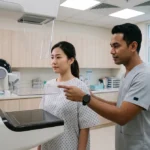
During the test, a radiographer places each breast in turn between two plates that press it flat for a few seconds. This can feel uncomfortable or briefly painful, but it helps get a clear picture with less radiation. The whole visit usually takes about 20 to 30 minutes.
Breast ultrasound uses sound waves, not X-rays. It is often used to look more closely at a lump or at an area seen on a mammogram, and in younger women with denser breasts. It is not a replacement for mammography in routine screening.
A normal mammogram is reassuring, but it can't rule out cancer completely. Some cancers are hard to see, especially in dense breast tissue, and some grow between screening rounds. If you notice a change, get it checked even if your last mammogram was clear.
Sometimes a mammogram shows something that needs a second look. Being called back is common, and most recalls turn out not to be cancer. Extra views, an ultrasound or a small tissue sample (biopsy) may be needed to be sure.
For women with dense breasts, the USPSTF found there is not yet enough evidence to say whether adding routine ultrasound or MRI helps. Your doctor can talk this through with you.
Blood tests such as CA 15-3 are not used to screen for breast cancer. They can be normal in women with cancer and raised in women without it. They are mainly used to follow up women who have already been treated.
You don't need to fast. On the day, avoid putting deodorant, talcum powder or lotion on your breasts and underarms, as these can show up on the images. A two-piece outfit makes changing easier.
If you still have periods, a week or so after your period is often more comfortable. Tell the staff if you might be pregnant, are breastfeeding or have breast implants.
Bring any previous mammogram or ultrasound reports and images, so the new pictures can be compared. Your doctor will explain your results and arrange any follow-up tests if needed.
Sources
1. WHO Position Paper on Mammography Screening: Recommendations by age and resource setting — World Health Organization, 2014
2. Breast Cancer: Screening (Final Recommendation Statement) — US Preventive Services Task Force, 2024
3. Breast cancer (fact sheet) — World Health Organization, 2026
4. The Global Breast Cancer Initiative — World Health Organization, 2021
5. Tumor Markers (fact sheet) — National Cancer Institute (US), n.d. (accessed 2026)
For routine screening, a mammogram is the recommended test. Ultrasound is a helpful extra test to check a lump or a specific area, but it doesn't replace a mammogram.
No. Tumour markers like CA 15-3 are not reliable for screening because they miss many cancers and can be raised for other reasons. They are mainly used after a breast cancer diagnosis.
WHO recommends organised screening from 50 to 69, while the USPSTF recommends starting at 40. Your doctor can help you decide, taking your risk and preferences into account.
It can be uncomfortable for a few seconds while the breast is pressed, but it is quick. Booking a week after your period may make it more comfortable.
Talk to your doctor. A strong family history may mean you need to start earlier, have extra tests, or be referred for genetic counselling.